
 +995 551 50 18 84




An attractive rendering, a recognisable brand name and a bustling sales office – all of these create an impression of reliability, but do not confirm the legal soundness of a specific project. A brand may have been in existence for years, whilst the individual project company set up for that specific development is only just starting work. The land may be mortgaged. The planning permission may have been granted on terms different from those promised in the advertising. The contract may be drafted in such a way that the buyer bears all the risks, whilst the seller bears almost none.
A developer’s reliability cannot be confirmed by a single document or a single review. It is necessary to cross-check several independent sources: the NAPR Register of Entrepreneurs, the cadastral extract, planning permission documents, the actual track record of completed projects and the text of the contract. Only by combining all this data can a reliable picture be obtained.
This article is a practical guide to vetting a property developer and a new-build property in Georgia. It covers four levels of due diligence: the company, the land, the planning permission and the contract. This material is for information purposes only and is not a substitute for an individual legal review of a specific transaction.
Short answer
No document, bank or well-known brand can guarantee that a house under construction will be completed on time. However, you can significantly reduce the risk before making an advance payment by: verify the seller’s legal status, check the title to the land and any encumbrances, ensure that the valid planning permission matches the advertised project, examine the actual progress of previous and current construction projects, and agree on a contract with phased payments and clear consequences for late payment.
Do not pay a deposit, if the developer fails to provide the cadastral code, does not supply a copy of the current planning permission, does not explain the relationship between the landowner and the seller, or suggests making a payment to a person not named in the contract. A single red flag does not always indicate fraud, but any discrepancy must be explained in writing before payment is made.
What exactly needs to be checked
A common practical mistake is to reduce the verification process to a single step, such as reviewing a single statement. In practice, the verification process is divided into four distinct stages, each of which addresses its own category of risks.
The first level is a legal entity. It is the specific party that signs the contract, receives the payment and bears responsibility. This may not necessarily be the same as the brand, the group of companies or the company that built the previous projects.
The second level — the plot of land and any encumbrances. Who is the owner, on what basis is the developer using the plot, are there any mortgages, charges or other restrictions, and how do these affect the flat being purchased?
The third level — project permissions and settings. Is there a valid planning permission in place, what exactly has been approved under it, and do these specifications match what is shown in the advert?
The fourth level — the contract, financing and the procedure for registering the right. How does the payment scheme work, who receives the money, what is the procedure for lifting the encumbrance, and how are the buyer’s rights secured before the building is commissioned?
It is essential to distinguish between: property developer’s brand — this is a trade name; group of companies — is a group of legal entities with different functions; project developer — a specific company that has been granted authorisation; landowner — may be an individual; a company that accepts money — may not correspond to any of those listed. Understanding this structure is the top priority.
| Subject of the audit | What to install | Where to look | Main risk |
|---|---|---|---|
| The selling company | Legal name, ID, signatory’s authority | NAPR Register of Entrepreneurs | The contract was signed by a person without authority or by a non-existent company |
| Land plot | Owner, encumbrances, intended use | NAPR public register, cadastral extract | Mortgage, seizure or non-compliance with the permitted use |
| Planning permission | Holder, details, validity period | Local authority, planning permission | The authorisation has expired, was issued for different parameters, or has been revoked |
| Actual progress of the construction work | Construction progress, adherence to deadlines | Site inspection, completed projects | Construction freeze, failure to deliver on promises |
| Contract | Liability of the parties, terms of payment, registration of title | Analysis of the contract text, independent solicitor | A loss of money without any real protection of the buyer’s rights |
Rapid risk assessment
| Level | What has been discovered | Decision |
| Green | The seller and the payee have been identified; title to the plot has been confirmed; the planning permission is valid and complies with the development plans; any significant encumbrances are explained in the documentation; the contract specifies the subject matter, timeframes, liability and the registration procedure | You can now proceed to an independent review of the contract and a re-check of the registers before making payment |
| Yellow | The land or planning permission is registered in the name of an associated company; there is a bank mortgage; the project has recently been amended; the deadlines for previous projects have been extended | Do not automatically decline, but request details of the contractual relationship between the companies, bank documents, the latest changes to the project and a written explanation of the timelines |
| Red | They refuse to provide a cadastral code or a permit; the information in the advertisement differs from the documents; they ask for the money to be transferred to a third party; the signatory’s authority has not been verified; the contract allows for unlimited changes to the property or does not specify a clear refund in the event of termination | Do not transfer any money until the discrepancy has been resolved; forward the documents to an independent Georgian lawyer |
This is neither a reliability rating nor a legal opinion: the outcome depends on the specific project documents and the contract.
What to get before making a booking or paying a deposit
Before making your first non-refundable payment, ask the seller:
- the full name and registration number of the selling company;
- the cadastral code of the plot of land;
- a recent extract from the land registry and a cadastral plan;
- a planning permission and any amendments made to it;
- a document confirming the developer’s right to use the plot, if they are not the owner;
- a draft contract, including all annexes, the flat plan and the finishing specifications;
- construction and payment schedule;
- bank documents confirming consent or the procedure for releasing the flat from the mortgage, if the plot of land is mortgaged;
- a list of completed projects carried out by the specific legal entity that is liable under the contract.
Failure to provide one of the documents does not automatically constitute bad faith. However, before making payment, it is important to understand the reason for the document’s absence and the legal consequences.
Don’t want to go through dozens of projects from scratch?
Please answer a few questions about the city, your budget, the stage of construction and your risk tolerance. We will then suggest options for you to compare and review the relevant documents.
[Take the quiz]
Checking the property developer
Before reading the project presentation, you need to ensure that: Who exactly will sign the contract and receive the money?. It is not always the company whose name is written on the construction site banner.
Full legal name and registration number — the first pieces of information you need to obtain from the sales department. Request the company’s official name and identification number, and obtain a current extract from the Register of Entrepreneurs of the National Agency for Public Registry of Georgia (NAPR) via official website. Check the registered partners or shareholders (to the extent possible), authorised representatives, the company’s status and the history of registration changes. The trading name under which the developer operates may differ from the official name of the registered organisation. The extract does not always reveal the full structure of beneficial ownership.
You can determine this from the register date of registration company. This is important: a brand may have been in existence for ten years, whilst the specific legal entity may have been set up just a year ago specifically for this project. Such a structure is not in itself a breach, but it does mean that the ‘brand’s track record’ is not the same as that of the selling company.
It is important to ensure that the person signing the contract has genuine authority: this must be confirmed by the articles of association or a power of attorney, and not merely by the title on their business card.
Design firm — a separate entity that a developer may set up for a specific project. If it is this company, rather than the group as a whole, that bears the financial and construction liabilities, the buyer must be aware that, should any problems arise, the parent company may not be directly liable to them.
Check that the seller is the same as the payee named in the contract. If the payee is a different party (a bank, an affiliated company or another entity), before making the payment, obtain and check the written contractual basis, the payee’s authorisation, the purpose of the payment and the consequences of transferring the funds specifically to that party.
Company registration confirms its legal existence and the details on file, but does not confirm its financial stability, nor does it guarantee that the construction will be completed.
The following deserve special attention: active restrictions and pledges with regard to the company itself. The Register of Businesses does not contain all the information regarding the organisation’s financial position. Legal disputes involving the company can be tracked via public sources, although a comprehensive analysis requires the involvement of a lawyer.
The size of the declared capital or the fact that the project company was only recently registered does not in itself allow us to assess whether there will be sufficient funds to complete the building. In practical terms, it is more important to establish the sources of funding, the existence of a bank loan, the actual pace of construction, the assets and completed projects of the responsible legal entity in particular, as well as the terms of the contract in the event of delays or insolvency. Some financial documents may be withheld; the lack of access must be offset by a more secure payment arrangement and an independent legal due diligence review.
A list of questions you should put to the sales department before making any payment:
- The full legal name of the selling company and its registration number
- Date of company registration
- Full name and position of the person signing the contract; basis of authority
- Is this company the owner of the plot of land, or is it acting on some other basis?
- Who is the actual recipient of the payments, to which account are they made, and what is the contractual basis, if the recipient is not the same as the seller?
- A list of completed projects carried out specifically by this company (not the brand)
- Are there any affiliated companies involved in the project, and what are their roles?
Land and cadastral extract
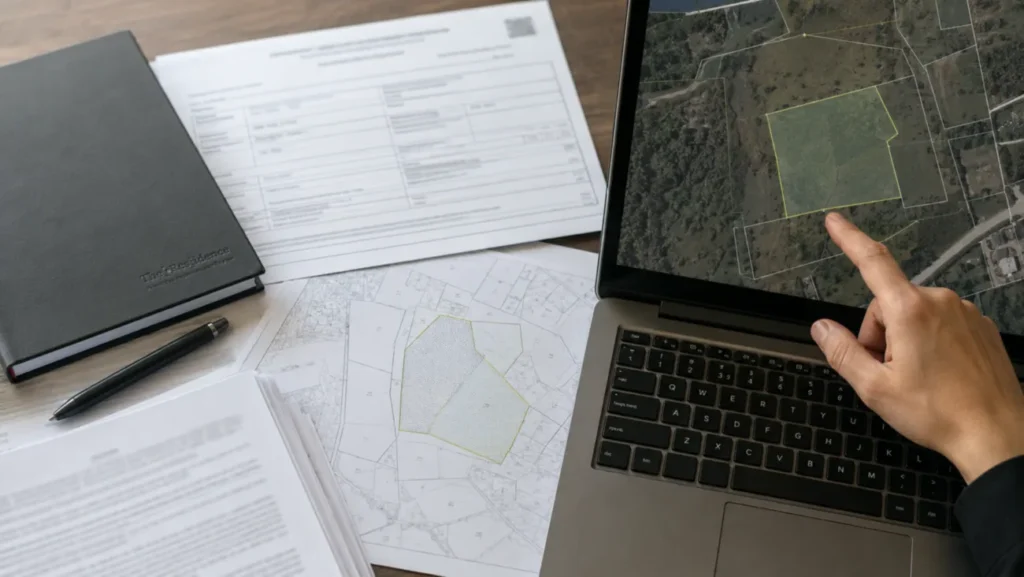
The right to a flat in a building under construction is inextricably linked to the legal status of the plot of land on which the construction is taking place. Before analysing anything else, it is necessary to obtain cadastral code of the plot and request a current extract from the Public Register.
How to survey a plot of land yourself
- Obtain the cadastral code from the sales department and ensure that it is included in the draft contract.
- Find the plot on the official NAPR cadastral map and check the address, boundaries and area.
- Order an up-to-date extract from the property register on the official NAPR website. The register allows you to obtain an extract and a cadastral plan; please base any legally significant conclusions on the official document, rather than on a listing on a commercial service.
- In the extract, check that the landowner matches the seller and the licence holder. Separately, check for mortgages, seizures, restrictions and registered liabilities.
- Please check again immediately before signing and before making any substantial payment: the status of the plot may have changed since the first check.
Important: A cadastral map helps you locate a plot of land, but it is no substitute for an up-to-date extract and an analysis of the contract.
You can obtain an extract from the land registry order via the official NAPR portal. The extract shows the information recorded in the relevant registers as at the date of its preparation, including ownership rights and any restrictions and encumbrances recorded therein. It does not confirm the absence of any unregistered agreements or unreported disputes.
The owner of the plot. If the land does not belong to the selling company, it is important to ascertain the legal basis on which the developer is carrying out the construction: a lease agreement, a joint investment agreement or some other document. This document must be provided to the buyer, rather than merely mentioned verbally.
Land use designation and permitted use. In the NAPR extract, the land use designation is primarily indicated as agricultural or non-agricultural. Permitted uses, development parameters and restrictions are set out separately — in town planning documentation, the detailed development plan (where available), the conditions for the use of the plot for construction, and planning permission documents. It is these documents that specify whether the proposed use and parameters of the development are permitted.
Mortgage on a plot of land — a charge whereby land is pledged as security for a loan. In the case of bank financing, the land may be mortgaged to the bank as security for the loan. This fact in itself does not constitute evidence of fraud. Before making payment, the buyer should obtain a written explanation of the mechanism by which the mortgage will not prevent the registration of the property being purchased: the bank’s consent, the terms of a partial release, or any other relevant document. The wording must take into account whether the flat is registered as a separate property in the land register.
In addition to the mortgage, the statement may also show: arrest (a prohibition on disposal imposed by a court order or by an enforcement authority), prohibition on disposal, rental (long-term tenancy, registered in the register), easement (right of way or right for third parties to lay utility lines). If the extract contains a legal claim, an obligation, an application for registration or any other outstanding entry, request details of its basis and status from NAPR and forward the documents to a solicitor. Do not automatically regard such an entry as either a valid right in rem or a harmless application.
You should request a statement not only when first selecting a property, but also immediately prior to a substantial payment: the status of the restrictions may have changed.
For more details on what to look out for when choosing a property, see the article entitled ‘How to check a property in Georgia before buying“.
| Entry in the records | What does it mean? | What else to ask for | When to call off a deal |
|---|---|---|---|
| A mortgage in favour of the bank | The land has been pledged as security for the loan | Agreement on the release of the flat from the security deposit upon payment | The mechanism for removing the encumbrance is not specified or is absent |
| Arrest | Prohibition on disposal by order of a court or authority | Information on the reason for and status of the arrest | The arrest is active and is not related to routine enforcement measures |
| Rentals | A third party has a registered right of use | Term of the lease and conditions for termination | The tenancy is long-term and will not be terminated until the transaction is completed |
| Easement | Right of way or right to lay utility lines | Area, location and impact on the project | The easement covers the area designated for development |
| Incomplete entry (claim, application) | The status and basis of the entry are unclear | Basis of the record and current status in NAPR | Pending receipt of a legal opinion on the nature of the entry |
Permits and the project
The mere fact that a plot of land is listed in the Public Register does not in itself prove the existence of a valid building permit. These are two fundamentally different documents, and confusing them is one of the most common mistakes made when inspecting a new-build property.
Let’s go through, step by step, exactly what needs to be checked.
- Right to a plot of land — Starting point: without a confirmed right to the land, construction cannot be lawful.
- Terms and conditions of use of the site — a document or decision issued by a local authority setting out the development parameters: intended use, number of storeys, density and setbacks. It is here that the boundaries of what is permitted to be built are laid down.
- Approved architectural plans and other planning permission documents. The architectural design defines the floor plans, façades and spatial arrangements. Structural, engineering and technical solutions may be set out in separate sections of the documentation. The contents of the package depend on the class and specific features of the development. The renderings used in advertising have been developed by the marketing team; the final design as approved in the planning permission documentation may differ.
- Planning permission — an official decision by the relevant municipal authority authorising the commencement of construction work. According to The Georgian Code on Spatial Planning, Architecture and Construction, a permit is issued for specific parameters of the property and is valid for a limited period. If the permit in your copy has expired, check whether it has been extended, amended or replaced by a new one. Continuing work without a valid legal basis may constitute a breach of the regulations.
- Changes to the authorisation or project must be duly approved or formalised by the competent authority and reflected in the current version of the permit and authorisation documentation. The purchaser must be aware of the current version of the approved design, rather than its original version.
- Commissioning of the building is formalised by the relevant administrative act. Class I buildings are not subject to the commissioning procedure provided for in Article 139 of the Code; the procedure for commissioning Class II–IV buildings is laid down by a government act. For the residential complex under review, its class and the applicable procedure must be determined. The existence of the act confirms that the prescribed procedure has been completed, but does not guarantee the absence of hidden construction defects. In a contractual context, the reference is to the issue of a certificate of acceptance of the building into service, rather than an ‘occupancy permit’.
The fact that a planning permission has been granted does not mean that the promotional claims fully correspond to the approved plans. Check the documents, not the renderings.
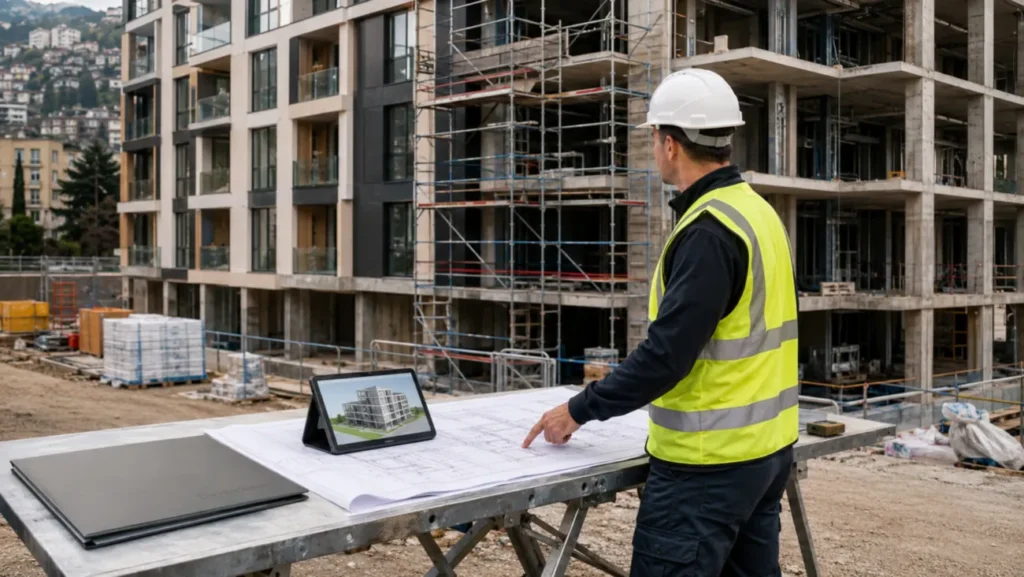
What exactly needs to be checked in the authorisation documentation:
- The address and cadastral code of the plot are the same as those stated in the contract
- The licence holder has been appointed; their role within the project structure — owner, seller or contractor — has been clearly set out in writing
- The number of storeys, floor area, intended use and key specifications are as stated in the promotional materials
- Construction is taking place in accordance with the approved phasing plan
- The licence is currently valid; where necessary, checks have been carried out to confirm whether it has been renewed or amended
- The changes made do not conflict with the seller’s material representations
- For completed buildings — the existence of an administrative certificate of acceptance of the building into service
Identify the holder of the planning permission and verify their relationship with the landowner, the seller and other parties involved in the project. If these are different individuals, check the documents setting out their respective powers and responsibilities regarding the construction, sale and transfer of the property.
Practical example: the promotional materials show a rooftop swimming pool, an underground car park and the hotel’s signature service. The buyer must determine whether these features are included in agreed draft, whether they are set out in the contract as the seller’s obligations, and what happens if they are not fulfilled. If there is no answer, this is not merely a marketing convention, but a matter that warrants a direct question requiring a written reply.
Project history and site inspection
A developer’s reputation is not built on the sales team’s words, but on what has already been built. Actual track record This is verified by checking specific addresses, completion dates and the quality of projects already handed over.
The first step is to draw up a list of completed and ongoing projects. For each one, you need to determine, what type of legal entity it was implemented. If different companies are behind different projects, they must be considered separately.
Next comes compare the stated and actual deadlines for properties that have already been handed over. Advertisements for flats in completed buildings and discussions with residents can be used as supplementary indicators. Verify actual dates using contractual documents, transfer deeds, the administrative certificate of the building’s commissioning, and data from the relevant authority. Recurring delays across several projects, particularly where no documented explanation is provided, should be considered a risk factor.
A physical inspection of two or three completed developments provides information that cannot be gleaned from the documentation. What to look out for:
- Condition of the façade: cracks, flaking plaster, signs of water damage
- The operation of the lifts and the general condition of the stairwells
- The quality of the water supply and the condition of the in-building networks
- Ventilation in flats and basements
- Waterproofing of roofs and service areas
- The provision of the promised communal spaces: lobbies, leisure areas and landscaping
For coastal properties in Batumi and Gonio, assess the waterproofing, ventilation, and any signs of condensation, corrosion or mould separately — the maritime climate places particular strain on these elements.
Talking to residents or the property management company gives a true picture of whether the developer has fulfilled its infrastructure obligations, how any issues were resolved after handover, and whether there are any legal disputes between the residents and the developer.
The progress of construction at the existing site needs to be to assess over time, rather than on the basis of a single visit. Active machinery, teams at work and regular updates on the construction progress are signs of a normal pace of work. Cranes standing idle, an empty site and a lack of progress over several months call for an explanation.
In hotel-managed apartment complexes, it is worth finding out separately how the management company operates during the off-season and what the actual results of the income programme are for properties that have already been handed over — not based on estimates, but on the actual payments made to owners.
In Tbilisi, particularly in areas undergoing active development, you should also assess the density of surrounding buildings, the plans for neighbouring plots, transport links and the strain on the utility infrastructure.
Funding and payment arrangements
Construction is financed from several sources simultaneously: the developer’s own funds, bank project finance and proceeds from sales. The balance between these sources affects the project’s stability. However, buyers generally do not have access to the developer’s financial statements; therefore, the analysis is based on indirect indicators and answers to specific questions.
If a developer claims to have secured bank financing, this may mean that the bank has carried out its own assessment of the project and set conditions governing its oversight. However, the extent of such oversight depends on the loan documentation, which is generally not available to the buyer. The bank’s involvement does not guarantee the completion of the construction, adherence to deadlines or the protection of the buyer’s payments. Ask for documentary evidence of the claimed partnership – not just a verbal account from a manager, but a specific document.
Confirmed bank financing may be subject to further verification and monitoring by the bank, but does not replace a review of the contract and does not guarantee the completion date or quality of the property.
The payment schedule requires detailed analysis. Key issues:
- Is the payment schedule linked to construction phases or only on specific dates
- To whom exactly is the money transferred, and to which account?
- What will happen to the funds already paid if construction is halted?
- What is the amount of the initial payment, and is it refundable if the contract is terminated?
- Is there a mechanism for conditional deposit or any other form of payment protection in place?
| Diagram | What to check | Risk to the buyer |
| Full payment in advance at an early stage | Returns, security, registration of rights/obligations, the seller’s financial position | Highly dependent on the developer’s ability to complete the project; the money has already been transferred |
| Instalments according to the payment schedule | Does the payment schedule correspond to actual progress; is it possible to suspend a payment in the event of a breach? | Payment may still be due even if the construction work is behind schedule |
| Payments by construction phase | Who verifies this stage and by what document; is there a right to carry out an inspection, and what is the deadline for rectifying the breach? | It’s better to link payment to results, but the wording is crucial |
| A project with bank financing | Bank participation document, mortgage, bank consent, procedure for partial release of a flat | The bank may oversee the project, but does not guarantee its completion and does not automatically protect the buyer |
| Escrow or other payment safeguards | Conditions for the release of funds, independence of the custodian, applicable law | It may reduce the risk, provided that the mechanism is genuinely accessible and clearly set out in the contract |
A large advance payment without a clear refund mechanism, registered security or other safeguards increases the buyer’s risk. Should the project be halted or the developer become insolvent, the procedure for obtaining a refund and the status of the claim will depend on the contract, registered rights, security and applicable insolvency rules – this should be assessed by a Georgian lawyer.
For a detailed explanation of how the payment schemes work, please see the article entitled ‘How do property instalment plans work in Georgia?“.
The currency, exact bank details and payment reference must be in accordance with the contract. A transfer made to different bank details or with a different payment reference creates legal uncertainty in the event of a dispute.
What to check in the contract
The contract is the key document in any transaction. It is the contract that sets out exactly what the buyer is receiving, within what timeframe, under what terms and with what safeguards. Signing a contract without an independent legal review, regardless of the transaction value, is a serious mistake.
The seller’s exact legal entity must match the company listed in the register. Any discrepancy in the name, identification number or the person signing the contract requires an explanation.
Identification of the object. The property must be identified as precisely as the project stage allows: the plot’s cadastral code, block, floor, flat number or project identifier, floor plan, projected floor area and boundaries. If the flat has already been registered as a separate entry in the register, check its specific cadastral code. Descriptions such as ‘flat in Block A’ without precise details do not allow for the unambiguous identification of the property being purchased.
Area and permissible deviation — The contract must specify both the planned floor area and the maximum permissible deviation in the final measurement. If the floor area can be changed unilaterally without the price being adjusted, this is a disadvantageous condition for the buyer.
The concept of ‘completion of construction’ In different contracts, this refers to different events: the issue of a certificate of completion, the actual completion of construction works, or the handover of the keys. It is important for the buyer to understand which of these events triggers their final payment and the transfer of title.
Deadline. It is advisable for the buyer to agree on a specific timeframe for the transfer — a specific date or a clearly defined event and a deadline — as well as clear consequences for any delay. Provisions relating to liquidated damages, refunds and compensation must be assessed for enforceability under Georgian law.
The developer’s right to amend the project — one of the most important conditions. A broad right to unilaterally alter the number of storeys, floor plans, materials, infrastructure and timelines effectively deprives the buyer of legal protection regarding the promises made at the time of sale.
Registration of a future right. Depending on the structure of the project and the relevant documents, it may be possible to register a future right or an obligation relating to the future transfer of the property with the NAPR. Such an entry may restrict subsequent registrations, but its scope and exceptions are determined by law and the agreement between the parties; it does not constitute an unconditional guarantee in the event of a change of ownership or the developer’s insolvency. Before making any payment, ask a solicitor for an extract and a written explanation of the specific type of entry.
If the buyer’s right or obligation is not registered and there is no other reliable security in place, their position in the event of a dispute or the seller’s insolvency may be significantly weaker. The specific status of the claim should be determined by a lawyer.
The process of paying off a mortgage The terms and conditions of the flat or plot of land being purchased must be clearly set out: under what conditions the encumbrance is lifted, who initiates the procedure, and within what timeframe.
| Terms of the contract | The wording preferred by the buyer | A worrying statement | What changes should be suggested? |
|---|---|---|---|
| Deadline for the handover of the property | A specific date or a clearly described event with a cut-off date | ‘Approximately’, ‘as and when ready’, indefinite extension | Set a specific deadline and specify the consequences of failing to meet it |
| Change to the project | Only substantial changes with the buyer’s consent | Unrestricted right to change the specifications, number of storeys and materials | Restrict the right to make changes or provide for termination with a refund |
| Refunds | A clear returns policy in the event of a breach by the seller, with a realistic timeframe | Partial repayment only, long repayment term, no interest | Consult a solicitor to assess the enforceability of the return conditions under Georgian law |
| Liability of the parties | Proportionate liability, understood by both parties | Hefty fines for the buyer and minimal liability for the seller | Adjust the liabilities to the balance sheet and assess their realisability |
The contract must be read in the language version that takes precedence in the event of a dispute. If the contract contains both Russian and Georgian versions and it is stipulated that, in the event of any discrepancy, the Georgian version shall apply, it is this version that must be analysed with the assistance of a qualified translator and a lawyer. Keep any promotional materials and correspondence: these may be used as evidence of the content of the seller’s public statements. Their legal weight and impact on the dispute will depend on the circumstances, the wording of the contract and the court’s assessment.
Red flags regarding the developer
None of the symptoms listed above, taken on its own, constitutes conclusive evidence of a problem. However, a combination of several warning signs requires that payments be suspended and the circumstances clarified before a decision is taken.
- Refusal to name the company that will be a party to the contract, and provide sufficient information to enable it to be verified in the NAPR. If the buyer is acting as a consumer and the seller as a professional trader, the seller must, prior to the conclusion of the contract, provide the information regarding their identity and address as required by the Consumer Protection Act. Regardless of consumer status, a refusal to identify a party to the contract is a serious red flag.
- Refusal to provide the cadastral code for the plot. Without it, it is considerably more difficult to carry out an accurate and reliable independent inspection of the site.
- The seller, the landowner and the recipient of the money are not the same person without a clear and documented legal explanation.
- Pressure to make a non-refundable deposit or booking as a matter of urgency — ‘only today’, ‘the price will go up’, ‘there are only a few flats left’.
- A payment made to an account not specified in the contract, without a written explanation its legal basis.
- Promises regarding returns, timeframes and infrastructure are made only verbally or in marketing materials without this being specified in the contract.
- Unclear status of the planning permission: No document is available; the validity period has expired without confirmation of renewal; it was issued with different specifications.
- Frequent changes to legal entities, directors or founders during the peak sales period.
- A non-transparent mortgage on a plot of land without a clear mechanism for waiving the charge when paying for a flat.
- Lack of completed projects when claiming to have many years’ experience in the market.
- An excessively broad right to amend the draft unilaterally, without the buyer’s consent and without the right to terminate the contract.
- A clear disproportion in liability: Heavy penalties for the buyer in the event of late payment, and minimal or no liability on the part of the seller for failing to meet deadlines.
If you find yourself facing several of these signs at the same time, do not proceed to the next stage of the transaction until the situation has been clarified and confirmed in writing.
What to do if construction has come to a standstill after payment has been made
- Make a record of the current state of the building works, the promised completion date and all correspondence.
- Please check the latest details regarding the company, the plot, any encumbrances and planning permission: the situation may have changed since the purchase.
- Send the seller a written enquiry asking for the reasons for the suspension, the new timetable and the source of funding.
- Before changing the payment schedule or suspending the next instalment, have the contract reviewed by an independent Georgian solicitor: failure to make a payment without authorisation may constitute a breach of contract on the part of the buyer.
- If the plot is mortgaged, check with the bank to find out the procedure for dealing with buyers and releasing the specific property from the mortgage.
- Discuss with a solicitor any claims, termination, registration or preservation of claims, interim relief and actions to be taken in the event of the company’s insolvency. The choice depends on the contract, registered rights and the stage of the project.
Do not rely on group chats as a substitute for formally documenting your requirements. Coordinating with other buyers may be helpful, but individual contracts and registered rights may vary.
Are there any documents relating to the selected property?
Please send us the cadastral code and the details of the purchase — we’ll help you draw up a list of questions and identify alternatives for comparison. The final legal opinion must be provided by an independent expert.
[Find alternatives]
Step-by-step verification procedure
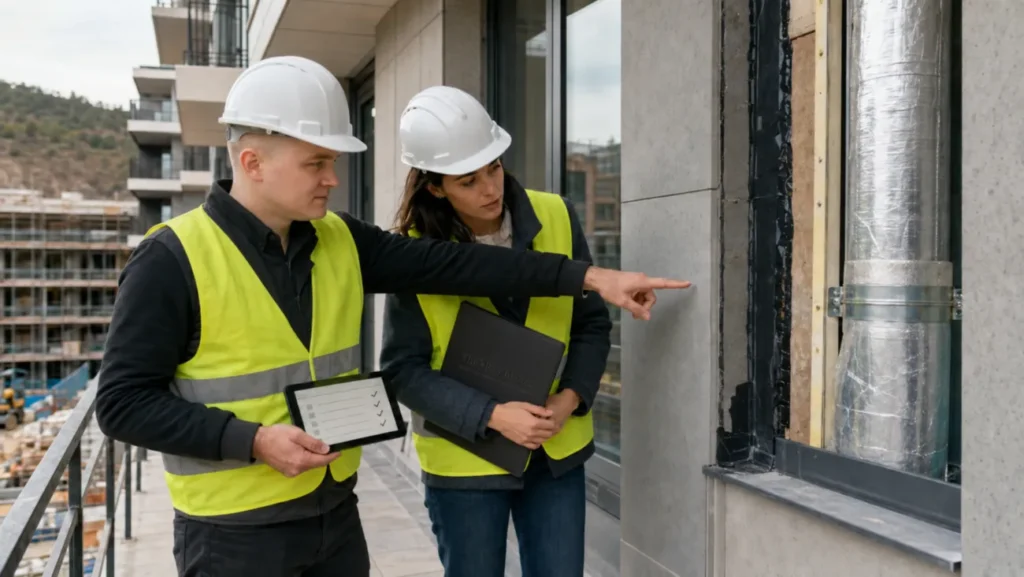
The verification process should not be a haphazard series of steps. Below is a step-by-step process, from the initial contact with the sales department through to the registration of title, covering all stages of the due diligence process. A comprehensive, step-by-step guide to buying property in Georgia can be found in a separate guide entitled ‘How to buy property in Georgia“.
- Obtain the legal name and company registration number of the selling company. Do this before any discussion of price and terms.
- Set up the company as the payee. Check with the seller against the contract; if there is a discrepancy, request written evidence of the contractual basis.
- Obtain a current extract from the NAPR Register of Entrepreneurs. Check the date of registration, the persons authorised to represent the company, and the history of changes.
- Obtain the cadastral code for a plot of land. Refusing to provide it is a red flag.
- Request an extract from the land registry for a plot of land. Check the owner, any encumbrances and registered entries; if necessary, consult a solicitor.
- Request a planning permission and the relevant planning documents. Check the holder, details, validity period and any changes made.
- Define the authorisation holder and their role within the project structure. Ensure that the relationships between the landowner, the licence holder, the seller and the payee are supported by documentary evidence.
- Compare the documents with the advertising claims. A swimming pool, car park, amenities and hotel brand – all of these must be included in the approved plans and in the contract.
- Check completed projects. Determine which company was responsible for their implementation; compare the original contractual deadlines, official amendments and the actual dates of commissioning.
- To inspect the building site and the completed properties. To speak to the residents and assess the quality of the building work and the performance of the management company.
- To analyse the funding and payment arrangements. Request confirmation of the bank’s involvement, verify the payee’s details and ensure that payments are linked to the relevant stages.
- Carry out an independent review of the contract. A solicitor acting in the buyer’s best interests, rather than one recommended by the seller.
- Double-check the key details before making any significant payment. Current land registry extract, permit status, company details.
| Stage | Document or action | Verification result | Status |
|---|---|---|---|
| 1. Legal entity | Name and ID from the NAPR Register of Entrepreneurs | In accordance with the contract | Verified / Needs clarification / Stop |
| 2. Payee | Bank details in the contract and invoice; grounds for discrepancy | Matches the seller’s details or is supported by documentation | Verified / Needs clarification / Stop |
| 3. Company details | Extract from the Register of Businesses | The date, representatives and revision history have been established | Verified / Needs clarification / Stop |
| 4. Cadastral code | Property code provided by the seller | The code has been received and matches the address | Verified / Needs clarification / Stop |
| 5. Land and encumbrances | Extract from the Land Registry | Owner, mortgage, enforcement orders, records checked | Verified / Needs clarification / Stop |
| 6. Resolution | Permits and current authorisation documentation | The details match those in the advert; the offer is still valid | Verified / Needs clarification / Stop |
| 7. The roles of the participants | Documents relating to the holder, the seller and the recipient | The structure is clear and has been verified | Verified / Needs clarification / Stop |
| 8. Verification of commitments | A comparison of the advert with the documents and the contract | Swimming pool, car park and brand name are specified in the contract | Verified / Needs clarification / Stop |
| 9. Project history | List of properties; contractual and actual deadlines | The discrepancies have been assessed | Verified / Needs clarification / Stop |
| 10. Inspection | A visit to the building site and the completed houses | Quality and performance have been assessed | Verified / Needs clarification / Stop |
| 11. Funding | Payment schedule, bank details, bank confirmation | The payment model is clear and reasonable | Verified / Needs clarification / Stop |
| 12. Contract | Independent legal assessment | The material terms have been agreed | Verified / Needs clarification / Stop |
| 13. Recheck | Up-to-date statements and authorisation status before payment | No changes | Verified / Needs clarification / Stop |
We, the team The Residence, we can help you find a property in Georgia that suits your objectives, budget and acceptable level of risk. Take the a short selection of properties, in order to obtain options for further examination and comparison.
Take a look at new-build properties in Georgia


 Batumi, Airport area
 from 27.2m²




What the buyer should keep
Once the contract has been signed and throughout the transaction, the buyer must retain a complete set of documents. If these are missing in the event of a dispute, it will be considerably more difficult to protect one’s interests.
Documents and materials that must be retained:
- Up-to-date extracts from the Register of Enterprises and the Land Registry — as at the date of signing the contract and as at the date of each material payment
- A copy of the building permit and all amendments made to it
- The approved floor plan of the flat being purchased and the specification of finishes, signed by the seller
- A signed copy of the contract of sale, together with all annexes and supplementary agreements
- Payment schedule — as set out in the contract
- Payment documents for each transfer: bank receipts, statements, confirmation of receipt
- Correspondence with the sales department regarding the key terms of the transaction: letters, instant messaging, email
- Documents confirming the removal of any encumbrance on the flat or plot of land, if such an encumbrance existed
- Handover certificate for the flat and list of defects drawn up upon collection of the keys
- Documents relating to the registration of title following the building’s commissioning
Promotional materials and leaflets received whilst selecting a property should also be kept: they may be used as evidence of the seller’s public statements. Their legal validity and impact on the outcome of a dispute depend on the circumstances, the wording of the contract and the court’s assessment.
Conclusion
A developer’s reliability is not determined by brand recognition or the scale of its advertising presence. It is demonstrated by the consistency of legal, regulatory, financial and factual data: when the company is listed in the register, the land is recorded in the Public Register, the permit is held by the local authority, and the track record of completed projects and the terms of the contract all present a coherent picture.
The Georgian new-build property market offers genuine opportunities. However, some significant discrepancies can only be identified by comparing several sources — and it is wiser to uncover them before making an advance payment or any other payment, the refund of which is restricted by the contract or may require legal action.
Do not transfer any substantial sum until any significant discrepancies between the documents and the seller’s representations have been explained and substantiated in writing.
 Property in Montenegro
 Property in Cyprus
 Real estate in UAE
 Property in Bali
 Property in Thailand
 Property in Spain
 Property in Saudi Arabia
 Property in Turkey
 Property in Zanzibar
 +995 551 50 18 84
 hello@residence-estate.ge
 Georgia, Batumi, Sherif Khimshiashvili str. 1, office 1204



 Get catalogue of TOP-7 objects