
 +995 551 50 18 84




There are usually two main ways to transfer money to Georgia to purchase property: either directly into the seller’s or developer’s bank account, or first into your own account with a Georgian bank. For new-build properties, payment in instalments according to a schedule is also commonly used, whereby the buyer pays a deposit, an initial instalment and subsequent instalments.
In addition to bank transfers, some buyers consider paying in cash or using cryptocurrency. However, these options are regulated differently from traditional bank payments. Virtual assets are not legal tender in Georgia, and their use for payments is restricted by law; therefore, the issues surrounding cash payments and cryptocurrencies are discussed in detail in separate sections of this article.
It is not usually necessary to open a bank account in Georgia for a direct international transfer. The buyer can send the money from their foreign account using the details specified in the contract or official invoice. Before making the payment, it is necessary to check the account holder’s details, the IBAN, SWIFT/BIC, currency, payment reference and commission charges.
For a large transfer, the bank may request the purchase contract and documents confirming the source of the funds. It is therefore advisable to clarify the bank’s requirements in advance and to send the payment well in advance of the date specified in the contract.
Important: the transfer of funds and the registration of ownership are separate stages. A SWIFT confirmation proves that the payment has been sent, but the buyer only becomes the owner once the transfer of ownership has been registered with the Georgian Public Register.
| The buyer’s situation | The most practical option | What to check in advance |
|---|---|---|
| Full payment in a single instalment | Direct SWIFT transfer to the seller or property developer | Contract, account holder, IBAN, SWIFT, currency and fees |
| Instalment plan from the developer | Scheduled transfers or payments from your own Georgian account | Tranche dates, the purpose of each payment and the validity of the bank details |
| Purchase on the secondary market | Bank transfer in accordance with the procedure set out in the contract | The seller’s title to the property and the link between payment and registration |
| Online shopping | International transfers and acting through a representative | Power of attorney, procedure for signing, protection against falsification of details |
| Proceeds from the sale of property | Bank transfer using a pre-prepared set of documents | Sales contract, statement of receipt and cash flow |
| The funds are held in cryptocurrency | Conversion via a registered provider and subsequent payment in fiat currency | The provider’s legitimacy, transaction history and proof of the origin of assets |
Important: If the buyer’s funds are held in cryptocurrency, this does not mean that the property can be paid for directly using digital assets. The National Bank of Georgia (NBG) It states that virtual assets are not legal tender, and payments made using them are prohibited, except in specific cases provided for in relation to the activities of virtual asset service providers (VASPs). Therefore, in practice, a lawful conversion into fiat currency is carried out first, after which payment for the property is made by standard bank transfer.
A brief guide to the procedure
For readers who need a quick overview of the steps involved:
- Select an item and make sure that the seller or developer is reputable.
- Obtain a contract, invoice or payment schedule with full bank details.
- Please specify the payment currency, payment method and any bank charges.
- Notify your bank in good time of any forthcoming large international transfer.
- Prepare documents confirming the lawful source of the funds.
- Please make the transfer, ensuring that the payment reference is correct.
- Save the SWIFT confirmation or payment order.
- Obtain written confirmation of the payment from the seller.
- Ensure that the payment complies with the contract and is linked to subsequent registration procedures.
Each of these steps is explained in detail in the separate sections below.
Important: An international transfer does not in itself confirm the transfer of ownership. The payment, the contract and the registration procedures must be consistent with one another.
Main payment methods
The choice of method depends on who the seller is, whether the buyer has an account with a Georgian bank, whether they are buying on the primary or secondary market, and how the transaction is structured. Below is an analysis of the three main options and a brief comparison of all the common methods.
Direct payment to the seller
One of the main options for an overseas buyer. The money is transferred from the buyer’s account at a foreign bank directly to the bank account of the seller — whether an individual or a property developer.
To make this type of transfer, you will need: the recipient’s IBAN, the recipient bank’s SWIFT/BIC code, the full name of the account holder, the name and address of the bank, and, in some cases, the details of the correspondent bank. The recipient’s name or company name must match that specified in the contract. A significant discrepancy in the recipient’s name or legal name may result in the transfer being subject to additional checks, delays or even being returned. Please check the spelling against the contract and the bank details, taking into account the transliteration.
A transfer to the account of a manager, estate agent or other intermediary is only permitted where there is an appropriate contractual basis and following verification by the bank, if required. Without this, such a payment creates legal uncertainty and additional compliance risks.
Once the payment has been made, you must keep the SWIFT confirmation and ask the seller for written confirmation that the payment has been credited.
| Data | What to include | Where to check |
|---|---|---|
| Recipient | The seller’s full name or the developer’s legal name | Contract and official invoice |
| IBAN | Recipient’s account number | An official document from the bank or the seller |
| SWIFT/BIC | Recipient bank code | A document containing the bank’s details and the bank’s official website |
| Beneficiary bank | Name and address of the bank | Official details |
| Account currency | GEL, USD or EUR — depending on the contract and the invoice | With the seller and the bank, pending payment |
| Payment reference | Contract number, property, payment type and buyer’s name | To agree with the seller and the bank |
| Commission | OUR, SHA or BEN | In the payment form and the contract |
| Correspondent bank | This is specified if required by the translation route | At the sending or receiving bank |
Transfer to your own account at a Georgian bank
The buyer first opens an account with a Georgian bank — for example, TBC Bank or Bank of Georgia — and transfers the funds there. Once the funds have been credited to the account, the buyer then pays the seller within the country.
This option gives you greater control over the currency and the timing of payments, simplifies recurring instalment payments and is convenient for ongoing expenses such as repairs, utility bills and property management.
However, Opening an account for a non-resident is not an automatic process. The bank makes decisions on a case-by-case basis and may request documents relating to citizenship, tax residency, source of income and the purpose of transactions. The fact that an account has been opened does not mean that the bank will automatically approve any incoming transfer: the bank is entitled to review large or unusual transactions separately.
Payment in accordance with the developer’s schedule
In many projects, payments are split into several instalments; however, the specific payment schedule is set out in the contract with the developer. A common option is: booking (payment to reserve the property), down payment, monthly or quarterly payments during the construction period and final payment when handing over the keys.
Each instalment must be checked against the contract: the amount, currency, deadline and purpose of the payment must match the schedule. Keeping your own record of payments made and retaining proof of each instalment is good practice, as it simplifies monitoring and helps resolve any disputes that may arise.
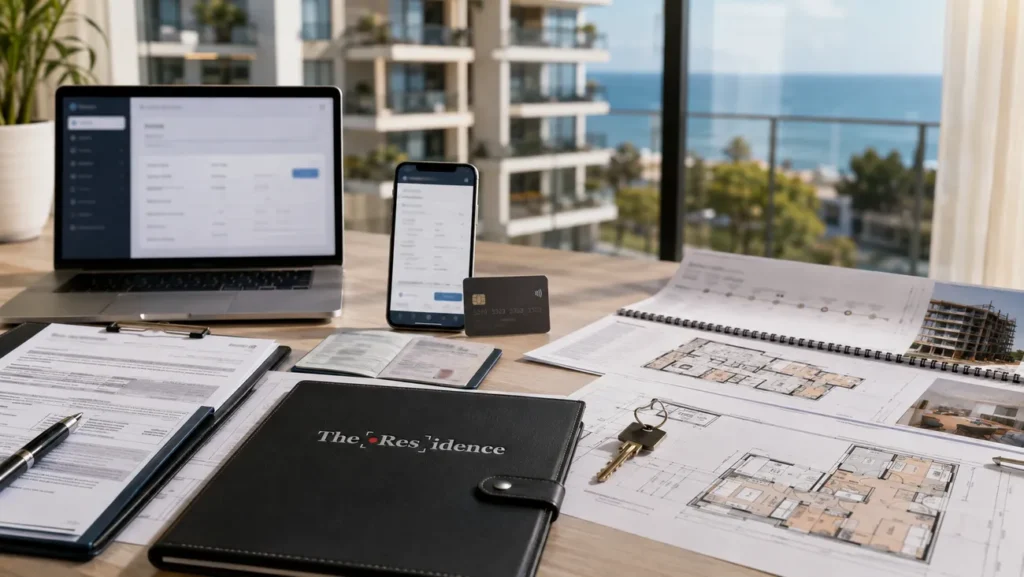
The table below lists all calculation methods, which could potentially be considered by foreign buyers. However, their legal status, banking practices and level of risk vary considerably.
| Method | When it’s time | I need a bank account in Georgia | Key documents | Main risks |
|---|---|---|---|---|
| Direct payment to the seller | A one-off payment or several instalments under the contract | No | Contract, invoice, payee details | Error in the payment details; the payee does not match the contract |
| Transfer to your own Georgian account | Instalments, currency conversion, subsequent costs | Yes | Documents required to open an account, contract | The account may not have been opened; the bank will still check large transfers |
| Internal transfer between Georgian accounts | Once the funds have been credited to your own account | Yes | Bank details, contract | An extra step, unnecessary fees |
| Instalment plan from the developer | Primary market with payment in instalments | No (but it’s handy) | Payment schedule, contract and invoice for each tranche | Discrepancy in the amount due to fees; change in the developer’s details |
| Cash payment | Rarely used in practice | No | Receipt, certificate, documentary evidence of payment | Customs declarations, risk of loss, difficulty in providing proof |
| Virtual assets (cryptocurrency) | Direct payment is prohibited as legal tender; prior conversion into fiat currency via a legitimate channel is permitted | No (for conversions — standard bank transfer) | Documents relating to the origin of assets, transaction history, and post-conversion documents | Direct settlement is prohibited by the National Bank of Georgia; exchange rate risk; the bank verifies the source of the assets |
For most foreign buyers, the most transparent option remains a bank transfer to the account details specified directly in a verified contract or official invoice. This method is the easiest to link to the transaction documents and to substantiate in the event of a dispute.
Example: what the payment for a flat costing $100,000 might look like
| Stage | Amount | Document |
| Booking | $2 000 | Booking Agreement |
| Initial instalment | $28 000 | Dogor and Invoice |
| Second payment | $35 000 | Payment Schedule and Invoice |
| Final payment | $35 000 | Final invoice and reconciliation statement |
Before making their first major transfer, the buyer usually provides the bank with the contract (or another document confirming the purpose of the payment) and the seller’s or developer’s bank details. The bank may request further information, depending on the nature of the transaction and its internal procedures.
If, under the contract, the developer is to receive the full amount without any deductions for fees, the buyer should choose a suitable method of allocating costs in advance and take into account any fees that the correspondent may charge. After making the final payment, the buyer should request a reconciliation statement or written confirmation that there are no outstanding debts.
The amounts and timetable are provided for illustrative purposes only. The actual terms and conditions are set out in the specific contract.
Cryptocurrency and cash
Some buyers are interested in the possibility of paying for property in cash or cryptocurrency. These methods differ significantly from standard bank transfers and require a separate assessment of the legal and banking risks involved. In Georgia, virtual assets are not legal tender; therefore, direct payment in cryptocurrency is subject to legal restrictions and is discussed in detail in a separate section of this article. Cash payments also require compliance with foreign exchange, customs and banking legislation.
Residential developments with payment in instalments


 Batumi, Airport area
 from 27.2m²




Do I need a bank account in Georgia?
For a direct international payment to the seller A local account for the buyer is not, as a rule, compulsory. You can transfer money from a foreign bank directly to the seller’s or developer’s bank details.
That said, having your own bank account in Georgia can be useful in a number of situations: when making instalment payments at different times, when you need to convert currency at a convenient time, or for ongoing expenses such as repairs, utility bills, taxes or property management. If the buyer plans to let out the flat or visit regularly, having a Georgian bank account makes these transactions considerably easier.
The bank’s decision to open an account for a non-resident is made on a case-by-case basis. The bank may request a passport, details of tax residency, address, employment or business, source of income, the purpose of opening the account and intended transactions. The list and format of documents required depend on the specific bank and the client’s profile. Possession of a residence permit or other residence status does not in itself guarantee that an account will be opened — the bank assesses a range of factors, including tax residency, source of income and the client’s economic ties to Georgia.
It is absolutely essential to understand that: Opening an account and receiving a specific large transfer are two different things. Even an active account does not preclude the bank from requesting documentation relating to a transaction. The bank is entitled to verify the source of the funds, the purpose of the payment and its connection to a specific transaction, regardless of how long the buyer has been a customer.
The fact that an account has been opened does not mean that every incoming transaction will be automatically approved. The bank may still verify the purpose of the transfer, the transaction documents and the source of the funds.
What to prepare before the transfer

Preparing the necessary documents before sending a transfer is one of those things that many customers put off until later. In practice, it is precisely the lack of the required paperwork at the right moment that causes delays or results in payments being returned.
Transaction documents
The list varies depending on the specific bank and the transaction, but in most cases the following will be required:
- a signed or provisional contract of sale — the main document linking the payer, the payee and the subject matter;
- official invoice or bill from the developer or seller;
- payment schedule, if the calculation is carried out in stages;
- the recipient’s bank details in an official format — not just via a messaging app;
- a certificate confirming the seller’s title to the property or the status of the property where the bank so requires;
- a document explaining the relationship between the payer, the purchaser and the payee, if they are different people — for example, when the money is sent by a spouse, but the contract names someone else.
The bank determines the required documents on a case-by-case basis. It is advisable to check with your bank in advance to find out exactly what will be needed for a specific transfer.
Verification of details
Before dispatch, each item must be checked:
- the full name of the individual or the legal name of the recipient company;
- IBAN;
- The recipient bank’s SWIFT/BIC code;
- the name and address of the bank;
- account currency;
- payment reference — contract number, flat or property number, buyer’s details;
- the correspondent bank’s details, if required for the transfer;
- Fee allocation type: OUR (all fees are paid by the sender), SHA (the sender pays the sending bank’s fee, whilst the recipient pays the fees of the correspondent banks and the receiving bank), BEN (all fees are deducted from the transfer amount).
Bank details must not be accepted solely from a message sent via a messaging app. These must be checked against the contract or an official document and verified via a known, independent channel of communication — for example, by calling the number listed on the developer’s official website, rather than via a chat service.
A secure procedure for verifying new account details
If your bank details have changed since the contract was signed:
- Do not use new information directly from an email or instant messaging service.
- Please request an official letter on the company’s letterhead.
- Please check the company’s legal name and registration number.
- Call the seller or developer using the number you already have, rather than the contact details in the new message.
- If the amount is substantial, ask the bank to check that the recipient is as specified in the contract.
- Record the change to the details in a supplementary agreement or another document recommended by a lawyer.
You should not carry out a ‘test transfer’ and regard it as sufficient verification: the successful crediting of a small amount confirms that the account is operational, but does not prove that the account belongs to the correct party to the transaction.
Agreement with the bank
Before making a large international transfer, you should contact your bank in advance and let them know:
- the amount and currency of the transfer;
- the recipient’s country and bank;
- purpose of payment (purchase of property);
- recipient’s details;
- estimated date;
- source of funds and purchase documents.
Advance notice does not guarantee that the transaction will go ahead — the bank will still assess the specific payment in accordance with its internal procedures. However, such a discussion helps to identify any potential requirements in advance and avoid being asked for documents at the last minute.
Before signing the contract, ask the bank not only about the fees but also whether the transaction is feasible in principle. It is a good idea to send the draft contract, the invoice and details of the recipient to a bank representative and obtain a written list of the required documents.
Preliminary bank approval does not guarantee that the payment will ultimately be made. However, it does enable any issues to be identified before the buyer commits to a firm payment deadline or makes a non-refundable deposit.
What to ask the seller or developer:
- Full bank details as set out in the official document.
- Written confirmation of the payment currency.
- The exact wording of the payment reference.
- An invoice or an approved payment schedule.
- Confirmation that the account belongs to the party specified in the contract.
- Procedure for settling commission payments: who pays the shortfall if the amount received is less than expected.
- Contact details of a member of staff who can confirm the enrolment.
This list helps to spot inconsistencies straight away — for example, if the recipient’s legal name does not match the project name or the developer’s brand.
Proof of the source of the funds

Georgian banks, like financial institutions in most countries, are required to assess large and unusual transactions. This requirement is enshrined in Georgian legislation: The Georgian Law on Measures to Prevent Money Laundering and the Financing of Terrorism requires banks to carry out due diligence on their customers and transactions. Compliance with these requirements is monitored by National Bank of Georgia.
In practice, this means the following: when a large sum is credited to an account — or when a customer makes an international transfer — the bank is entitled to request confirmation of the source of the funds.
In banking terminology, a distinction is made between two concepts. Source of funds — the source of the specific funds involved in the transaction: wages, proceeds from the sale of a flat, dividends. Source of wealth — the overall history of the customer’s wealth accumulation. Depending on the customer’s profile and the risk assessment, the bank may verify the source of specific funds, the overall origin of the customer’s wealth, or both.
A verbal explanation alone is usually not enough. The documents must show a logical, unbroken chain: Money received from a specific source — credited to an account — is transferred to the seller. Any gaps in this chain — for example, cash deposited without explanation, or a transfer routed through several accounts without supporting documentation — may raise further questions.
The bank assesses not only the existence of a specific statement, but also the overall rationale behind the transaction: who received the money, how it was credited to the account, and why it is being transferred to that particular seller.
A request for documents is not an accusation. It is a standard procedure that the bank follows in accordance with its internal rules and legal requirements. The specific list of documents is determined by the bank on a case-by-case basis.
Table 2. Documents by source of funds
| Source of funds | Possible documents | What the chain should show |
|---|---|---|
| Salary | Income statements, tax returns, employment contract, bank statements | Regular payments from your employer into your account — savings — transfer |
| Income from business activities | Financial statements, tax returns, company bank statements, profit distribution documents | Company income — payment into a personal account — bank transfer |
| Dividends | Decisions on dividend payments, brokerage statements, bank statements | Dividend payment — crediting to an account — transfer |
| Property for sale | Contract of sale, proof of transfer of title, bank statement confirming receipt of payment | Sale of the property — receipt of funds — transfer |
| Sale of a car or other property | Sales contract, registration documents, proof of payment | Sale of an asset — receipt — transfer |
| Savings | Bank statements for the period in question, confirming the gradual accumulation of the amount | Transaction history — account balance — transfer |
| Inheritance | Certificate of entitlement to an inheritance, documents showing the value of the property, statement of credit | Receiving an inheritance — funds credited to an account — transfer |
| Donation | Deed of gift, documents relating to the donor, bank statements | Receipt from a donor — crediting — transfer |
| Loan | Loan agreement, loan disbursement certificate, statement of funds credited | Loan disbursement — funds credited to account — transfer |
| Investment income | Brokerage statement, confirmation of position closure, statement | Sale of assets — proceeds — transfer |
| Funds belonging to a spouse or relative | Documents relating to the payer, a contract or a letter regarding a gift or loan, and statements from both parties | Source of funds from the payer — transfer — receipt into the buyer’s account |
| Sale of securities or crypto-assets | Report from a broker or registered VASP, transaction history, conversion documents, bank statement | Acquisition of an asset — its sale or conversion — receipt of fiat money — transfer to the seller |
| Funds from the buyer’s company | Financial statements, a dividend resolution, a loan agreement or other document, bank statements | Legitimate source of the company’s funds — legal basis for the transfer to an individual — receipt — transfer |
The bank may request a translation of the documents, a certified copy or further proof of their authenticity. Whether notarisation, an apostille or legalisation is required depends on the type of document, the country in which it was issued and the specific bank’s requirements.
A special case: different faces. If the contract specifies a single buyer, but the transfer is made by a spouse, relative, partner or company, this arrangement must be agreed with the bank in advance and explained in writing. The same applies where the payee is not the same as the seller specified in the contract.
Splitting a large sum in order to circumvent compliance checks is a risky practice that may attract increased scrutiny from banks and is not recommended.
Currency, fees and timeframes
In the property market, parties often discuss the price or specify its equivalent in US dollars or euros. However, the lari is the sole legal tender in Georgia, and separate rules on price display apply to businesses. Therefore, the contract must clearly specify the amount of the obligation, the currency clause, the applicable exchange rate and the currency in which payment is to be made. These terms must be checked with a Georgian lawyer and a bank before sending the money.
The issue of currency is also important from a practical point of view: if you transfer money in a currency other than that specified in the contract, without prior agreement, additional conversions, unwanted exchange rate losses or technical difficulties may arise during crediting.
The choice of payment currency depends on three factors: the currency in which the contract price is stated, the currency in which the seller’s account is held, and which currency is more convenient for the specific buyer in terms of fees and currency conversion.
Double conversion
If the buyer holds their money in euros, the contract is in dollars, and the seller’s account is in lari, a currency conversion is inevitable when the transfer is made – and there may even be two. Each conversion is carried out at the bank’s exchange rate, which is usually less favourable than the official reference rate. The resulting losses can be significant when large sums are involved.
An example of losses resulting from double conversion
The buyer has €100,000, the price of the flat is fixed in US dollars, and the seller accepts payment into a lari account. In this case, the money may first be converted from euros to US dollars, and then from US dollars to lari.
If the combined difference between the market rate and the banks’ rates across the two exchanges amounts to, say, 2%, the losses will amount to the equivalent of €2,000. With a difference of 3%, the losses will already amount to €3,000.
This is not an official bank rate, but an example of why, before making a transfer, you should check the actual exchange rate, calculate the final amount you will receive and, where possible, avoid unnecessary currency conversions.
| The difference between the expected and actual exchange rate | Losses totalling $50,000 | Losses totalling $100,000 | Losses totalling $150,000 |
|---|---|---|---|
| 0,5% | $250 | $500 | $750 |
| 1% | $500 | $1 000 | $1 500 |
| 2% | $1 000 | $2 000 | $3 000 |
| 3% | $1 500 | $3 000 | $4 500 |
The table shows the mathematical difference, not a specific bank’s exchange rate. Before making a transfer, compare not only the official exchange rate but also the actual amount the seller will receive after conversion. The National Bank’s official exchange rate is for reference purposes only and is not necessarily the same as a bank’s commercial exchange rate.
Committees
The cost of an international transfer is made up of several components:
- commission charged by the sending bank — charged for processing and sending the transfer;
- correspondent banks’ commission — one or more intermediary banks may retain their share, although it is not always possible to determine the exact amount in advance;
- the receiving bank’s commission — charged when the funds are credited to an account in Georgia;
- currency conversion — the difference between the official exchange rate and the bank rate.
The commission allocation type (OUR, SHA or BEN) determines who bears the costs. When selecting OUR The sender declares that they will cover the commission fees — this reduces the likelihood of the costs being deducted from the principal amount, but does not guarantee that the exact amount will be received across all correspondent routes. It is best to set out in the contract who is responsible for covering any shortfall. In the event of SHA Each party pays their own bank’s fees, but correspondent bank charges may reduce the final amount. When BEN All commission fees are deducted from the transfer, and the seller receives less than the amount sent.

Table 3. What makes up the cost of a translation
| Consumption | Who installs it? | When it happens | How to check in advance |
|---|---|---|---|
| Commission charged by the sending bank | The buyer’s bank | When initiating a transfer | Bank charges or a call to a branch |
| Correspondent’s commission | Intermediary bank | When passing through the SWIFT network | Check with your bank for an approximate process; it is difficult to know the exact amount in advance |
| Fee charged by the receiving bank | The seller’s Georgian bank | Upon crediting to the account | Ask the seller or the recipient bank directly |
| Currency conversion | The bank carrying out the conversion | In the event of a currency mismatch | Check the exchange rate in advance; compare it with the official rate |
| Exchange rate difference | Market price + bank spread | Constantly | Track the exchange rate during the settlement period |
| Additional costs (translation of documents, apostille) | Notary, translator | When preparing documents for the bank | Check with the bank regarding the documentation requirements |
A hypothetical example: If, under the terms of the contract, the seller is due to receive exactly $100,000, the buyer should check in advance with their bank and the seller what type of commission has been agreed and who will cover the difference if the final amount turns out to be less. You should not assume that sending exactly $100,000 will guarantee that this exact amount is credited.
Example of a translation quote
Let us assume that, under the terms of the contract, the seller is due to receive exactly $100,000. The sending bank reports a commission of $150, but the exact commission charged by the intermediary bank is not known in advance.
Under the SHA option, the correspondent bank may, for example, deduct a portion of the costs from the transfer amount. If $40 is deducted, the seller will receive $99 960, and the buyer will have to make an additional payment.
Under the OUR term, the commission is usually paid by the sender in addition to the principal amount. In this case, $100 150 may be debited from the buyer’s account, plus any additional charges incurred along the correspondent banking chain. However, even the OUR option should not be regarded as an absolute guarantee that exactly $100 000 will be received.
The figures in the example are for illustrative purposes only. You should check the actual rates with your bank before making the payment.
Specific fees depend on the bank, the transfer method, the currency and the amount of the transfer — please check these directly with your bank before making the transfer. Up-to-date information on transfers via Georgian banks can be found on their official websites, for example at the TBC Bank translations page.
The time taken for an international transfer depends on the sending bank, the currency, the time the transfer is initiated, the chain of correspondent banks, public holidays and any compliance checks that may be required. The bank may provide an estimated timeframe, but It is usually not possible to guarantee a payment date before all checks have been completed. You can check the current guidelines on the bank’s official website or when making the payment. It is therefore advisable to send the transfer well in advance of the deadline specified in the contract.
How much time should be allowed for this?
For a standard international transfer, it is advisable not to schedule the payment for the last day specified in the contract. Even if the bank gives an estimated timeframe of several working days, the transaction may take longer due to the correspondent bank, bank holidays, time zone differences or compliance checks.
It is generally safer to send a large payment at least 5–7 working days before the agreed deadline. If the transfer is coming from a country or bank with a higher risk of sanctions or compliance issues, you should allow for a longer lead time and agree in advance with the seller on the procedure to follow in the event of a delay.
This is not a guaranteed processing time: only the bank handling the transfer can confirm the specific route and duration of the transaction.
| Stage | A practical guide | What might extend the duration |
|---|---|---|
| Verification of documents by the bank prior to the transfer | From one working day, but no guarantee | An unusual amount, foreign documents, additional requests |
| Processing by the sending bank | It depends on the time of submission and internal procedures | Submission after the cut-off date, on a weekend or a public holiday |
| Transactions via correspondent banks | A few working days in a typical scenario | Additional checks, sanctions-related restrictions, a complex route |
| Crediting by the receiving bank | Once received and the verification process has been completed | Request for a contract or proof of funds |
| Obtaining confirmation from the seller | Usually, once the money has been credited to the account | Accounting procedures at the property developer |
| Recommended stock level prior to the contract expiry date | At least 5–7 working days | For a challenging route, it’s best to take extra provisions |
These are guidelines for planning purposes only, not guaranteed bank processing times. Before signing the contract, check with the bank whether a specific transfer route is available and ensure that the contract sets out the procedure to be followed in the event of a delay.
Please bear in mind the bank’s processing times
An international transfer sent after the bank’s cut-off time for payment orders may not actually be processed until the next working day. Weekends and public holidays may vary between the sender’s country, the correspondent bank’s country and Georgia.
Before making a large payment, please check the following:
- SWIFT order acceptance times;
- the value date;
- whether the following day is a working day for all banks on the route;
- when the bank begins checking the documents;
- Is it possible to submit the contract to the compliance department in advance?
How to specify the payment reference correctly
The payment reference is a field that is most often filled in as a formality or left blank altogether. In practice, it serves an important function: it links the money to a specific transaction and helps the bank, the seller and the buyer to identify the transaction unambiguously.
The appointment must be in accordance with: under the contract (number and date), invoice (if one is displayed), to the object (flat or plot number), payment type (deposit, initial payment, subsequent instalment, final payment) and the customer’s details.
International transfers are usually drawn up in English — using the Latin alphabet. Here are three templates that you can use as a basis, but be sure to check them with your bank and the seller before using them:
1. Payment under the Property Sale and Purchase Agreement No. [number] dated [date], flat [number], buyer [name].
2. Instalment payment under Agreement No. [number], property unit [number], buyer [name].
3. Final payment under Property Purchase Agreement No. [number] dated [date].
Vague phrasing such as private transfer or gift are not suitable for paying for property — they do not reflect the nature of the transaction and may raise further questions from the bank.
Contract and property reference number enable the seller and the developer to quickly identify a payment amongst dozens of incoming transfers. This is particularly important when paying in instalments: without a clear reference, the developer’s accounts department may allocate the funds to the wrong instalment or ask you to provide clarification.
The maximum length of the payment reference depends on the bank’s interface and the payment format used. If the full text does not fit, priority should be given to the contract number, the object identifier, the payment type and the buyer’s name — having first agreed the abbreviated wording with the bank and the seller.
What to include in the contract before transferring money
A banking transaction must comply with the terms of the contract. Before signing, check that the document specifies:
- the full price of the property;
- the currency of the liability and the currency of the actual payment;
- the exchange rate or the method for determining it upon conversion;
- the recipient’s bank details;
- whether a payment from a spouse, relative or company is permissible;
- the type of each payment: booking fee, deposit, down payment, instalment or final payment;
- who pays the bank and correspondent bank fees;
- Is an obligation deemed to have been fulfilled when the money is debited or after it has been credited to the seller?;
- What happens if a bank delays or returns a transfer;
- the period within which the buyer may provide proof of dispatch;
- the procedure for amending details;
- the link between payment and the signing of the contract, the handover of the property and the registration of the title.
It is particularly important to determine the point at which the obligation is fulfilled. If the contract stipulates that payment is only deemed to have been made once the full amount has actually been credited, the deduction of a commission or a delay on the part of the correspondent bank could, strictly speaking, result in underpayment or late payment, even if the buyer sent the money on time.
Payment for new-build properties and instalment plans
Buying a flat from a developer in Batumi, Gonio or Tbilisi often involves choosing between paying the full amount upfront, making an initial deposit with instalments, or opting for a personalised payment plan. It is important to understand the payment structure whilst you are still at the stage of selecting a property.
Booking — the first payment, which secures a specific flat for the buyer. Reservation terms vary: before making the payment, you must check how the payment is described in the document, whether it is included in the property’s price, under what circumstances it is refundable, and what the consequences are should the buyer or seller withdraw from the agreement. The status of the payment — whether it is an advance, a deposit or another type — determines its legal status and is clearly set out in the text of the contract.
Initial instalment Subsequent payments are made in accordance with a schedule linked to the construction phases or to a timetable. Each instalment must specify: a fixed amount, a specific date or condition triggering the payment, the currency and the recipient’s bank details.
One of the practical details: The project brand and the recipient legal entity may not be the same. For example, the project is called ‘Batumi Hills’, and the account belongs to ‘Real Estate Development LLC’. Before making any transfer, you should ensure that the recipient’s legal name matches the one stated in your contract.
During a long-term construction project, the company’s bank details may change due to reorganisation, a change of bank or a change of account. Any change to the details must be cross-checked against the official document, rather than simply taking it at face value from an email or instant message.
After each payment, please save:
- payment order;
- SWIFT confirmation;
- bank statement;
- notification of enrolment (if the developer sends one);
- a receipt or reconciliation statement from the developer;
- updated balance as per the schedule.
This archive will enable you to quickly retrieve the payment history and provide evidence of each payment in the event of any dispute.
Find a property that suits your budget and preferred payment method. Please answer a few questions so that The Residence team can suggest suitable properties in Batumi, Gonio, Tbilisi and other parts of Georgia. Go to the property search
Purchase on the secondary market
Dealing with a private seller requires particular care in several respects.
Verification of identity and ownership. Before transferring funds, the buyer must ensure that the seller is indeed the lawful owner of the property. The extract reflects the information recorded in the Public Register at the time it was issued: the owner, registered rights, restrictions, charges and other entries. The extract is a key document for due diligence, but it does not replace an analysis of the contract, the property’s history and other legal risks.
The seller’s details must match across the register, the contract and the bank details. If one person is listed in the register, another is named in the contract, and the account details belong to a third party, this is a reason to pause and investigate. Every discrepancy must have an explanation and be supported by documentary evidence.
Choosing when to pay. The order – whether payment comes first or registration – is not a one-size-fits-all question. It depends on the structure of the transaction, the method of registration and the arrangements between the parties. The procedure for payments and registration must be set out in the contract. Full prepayment before the registration process is completed poses a risk to the buyer; payment after registration poses a risk to the seller. The parties may agree on a mechanism to bridge this gap: for example, by using a banking or registration service available for that specific transaction, or by setting out the sequence of actions in detail in the contract. The availability and terms of escrow must be checked with the relevant bank, notary or the NAPR – it is not applied automatically.
How long does it take to register ownership?
Once the transfer of title has been calculated, it must be registered in the Public Register. According to NAPR’s official fees, the cost of registering the creation, amendment or termination of a right in respect of immovable property is:
| Registration deadline | State duty |
| 4 working days | 150 GEL |
| 1 working day | 270 GEL |
| On the day the application is submitted | 350 GEL |
The certification of the parties’ signatures on a transaction submitted for registration is charged separately at 7 GEL. An electronic extract from the register within the standard timeframe costs 13 GEL, whilst a paper extract issued within one working day costs 20 GEL.
These fees relate to the Public Register’s government services. Translation, legal support, notarial services and the preparation of foreign documents are charged separately.
Acting through a representative. If the seller is selling through an authorised representative, it is essential to check the power of attorney: its validity, the scope of the representative’s authority, and whether it has been revoked.
For more details on the procedure for property transactions in Georgia, see the article ‘How to buy property in Georgia“.
How to pay for your purchase remotely
Buying property in Georgia without visiting in person is common practice. An international bank transfer allows you to pay for the transaction remotely, provided that the sending bank, the currency of payment, the correspondent banking route and the receiving bank support such a transaction. You must confirm that the transfer is possible before signing the contract and setting the payment deadline. The organisational aspects generally require more thorough preparation than when the buyer is present in person.
A distance contract This can be carried out through a representative acting under a power of attorney. If the power of attorney is drawn up outside Georgia, please check in advance the requirements regarding notarisation, apostille or legalisation, translation into Georgian, and the scope of authority required for the registration of the specific transaction. The power of attorney must clearly specify which actions the representative is authorised to perform and which they are not. A representative should not automatically be the recipient of the entire sum, unless otherwise provided for in the agreed transaction structure.
Exchange of documents With online purchases, transactions take place via email and messaging apps. This is precisely where the risk of identity theft arises: fraudsters may intercept correspondence or create a fake email address impersonating the developer or estate agent.
When making a purchase remotely, it is best to verify the details using two independent methods: by checking an official document and via a previously known contact for the seller or developer.
Monitoring of registration activities In a remote transaction, this responsibility usually falls to a representative or a solicitor. The buyer must clarify in advance exactly when to transfer the money — before or after registration — and how proof of registration will be provided.
For more information on online shopping, see the article ‘How to buy property in Georgia remotely“.
Buying property with cash
The possibility and procedure for cash payments must be specifically agreed in the contract and verified in accordance with Georgian law. The lari is the sole legal tender in Georgia; therefore, payment in foreign currency cannot be regarded as a universally acceptable method — it is advisable to check the applicable requirements with a lawyer and your bank in advance. Furthermore, cash payments involve significant practical difficulties.
When importing into or exporting from Georgia cash and securities with a total value exceeding 30,000 GEL or the equivalent in another currency, declaration is mandatory. You should also check the rules of the country from which the money is being taken out: its threshold and declaration procedures may differ.
Failure to declare goods, or making an inaccurate declaration, may result in more than just a delay in receiving your money at the border. The Customs Code provides that:
- for amounts between 30,000 and 50,000 GEL — a fine of 3,000 GEL or confiscation;
- for amounts exceeding 50,000 but not exceeding 100,000 GEL — a fine of 5,000 GEL or confiscation;
- for amounts exceeding 100,000 GEL — a fine of 10% of the relevant amount or confiscation.
Therefore, paying in cash cannot be regarded as a simple way of avoiding a bank check.
Even a correctly completed customs declaration does not replace proof of the origin of the funds. If the cash is subsequently deposited into a bank account, the bank is entitled to request documents showing the source of the money and its movement.
A bank accepting cash for crediting to an account or for settling a transaction is entitled to request confirmation of the origin of the funds — in the same way as for a non-cash transfer. The buyer is solely responsible for the security of the transport of a large sum of money.
Another complication is the paperwork involved. A receipt or acknowledgement of receipt for cash must clearly link the payment to the contract. In the event of a dispute, it is more difficult to prove that payment was made in cash than it is when there is bank confirmation.
Buying property with cryptocurrency
Virtual assets are not legal tender in Georgia. The law prohibits the use of virtual assets to pay for goods and services, except in specific cases necessary for the provision of services involving virtual assets. Therefore, direct payment for a flat using cryptocurrency should not be described as a standard, lawful method of payment.
If capital is held in cryptocurrency, the practical approach usually involves converting it into fiat currency via a provider authorised to offer such services. The National Bank regulates and registers VASPs and specifically warns of the risks involved in dealing with unregistered providers.
Before conversion, please check the following:
- Is the provider registered with the National Bank of Georgia?;
- whether he will be able to provide proof of the transaction;
- in whose name the fiat money will be received;
- Will the bank accept documents proving the origin of crypto-assets?;
- what the tax implications are in the buyer’s country of tax residence.
What to do if a transfer is delayed
Even a correctly processed international transfer may be temporarily delayed due to a bank check, the need to clarify documents, errors in the payment details or other reasons. Below, we outline the most common situations and steps you can take to help you identify the cause of the delay more quickly and decide on the correct course of action.
Common situations where delays occur and the procedure to follow
The translation is currently being checked
The sending or correspondent bank may request additional documentation relating to the transaction — this is standard procedure and no cause for alarm. It is recommended that you:
- contact the sending bank to check the status;
- to provide the contract and the documents relating to the transaction;
- notify the seller in writing of a possible delay;
- Secure all utilities.
The recipient received less
Possible causes: correspondent bank fees, the selected fee allocation method (SHA or BEN), currency conversion. You should:
- obtain a detailed breakdown of the transaction from your bank;
- agree with the seller on how to pay the outstanding amount.
The translation has been returned
Possible reasons: an error in the payment details, a discrepancy in the beneficiary’s name, restrictions imposed by the correspondent bank, or insufficient documentation. If a payment is returned, you should check with your bank to find out the exact reason, correct the error and resubmit the payment. Please note: fees may be deducted in the event of a return.
The bank details have changed
If a seller or property developer notifies you of a change to their contact details, this is one of the most common types of fraud (Business Email Compromise). Do not transfer money using the new bank details until you have independently verified them via an official document and through a pre-arranged, non-electronic channel — for example, a call to a telephone number listed on the official website.
The seller has not confirmed receipt
Gather evidence on your part: the payment order, a copy of the SWIFT message, a bank statement and any correspondence. You can request a payment trace through your bank. In the event of a dispute, it is advisable to consult a solicitor — whilst the bank can provide official confirmation that the payment has been processed, resolving disagreements between the parties to the transaction requires separate legal assistance.
Common mistakes
Most of the problems encountered when transferring money to purchase property in Georgia are not due to technical glitches at banks, but to a lack of preparation. Here are the ten most common mistakes:
- Sending money before the property and the seller have been checked. Transferring money is an irreversible action. You must verify the seller’s ownership before making the payment.
- Using contact details from the messaging app only. Bank details must always be verified against an official document.
- The account holder is not the same as the seller under the contract. Any discrepancy requires an explanation.
- A vague or missing payment reference. The term ‘transfer’ does not link the money to the transaction.
- Lack of documentation regarding the source of the funds. The bank is entitled to request them at any time.
- Ignoring correspondent banks’ fees. The recipient may receive less than the agreed amount.
- Sending in the wrong currency without prior agreement. An unauthorised conversion may breach the terms of the contract.
- Splitting a payment in order to circumvent compliance checks. This makes the situation worse, rather than simplifying it.
- A transfer to an intermediary without a contractual basis. Money sent to an agent or manager without a proper contract creates legal uncertainty.
- No confirmation of payment or reconciliation statement. Without written confirmation from the seller, the payment cannot be considered finalised.
Pre-payment checklist

Use this list as a final check before each translation.
Property and seller:
- The property has been inspected and ownership has been confirmed by an extract from the register
- The seller or developer has been identified; the legal name matches that in the contract
- In the case of the secondary market, the absence of encumbrances and charges has been confirmed
Documents:
- The contract has been signed or agreed upon
- Invoice or payment schedule received
- Documents certifying the source of the funds have been prepared
- The payer details document (if the sender is not the same as the buyer) is ready
Bank details:
- The IBAN has been verified against an official document, not just against correspondence
- SWIFT/BIC verified
- The recipient’s legal name is the same as that stated in the contract
- The currency of the recipient’s account has been confirmed
- The payment reference has been agreed with the bank and the seller
Financial aspects:
- The fees charged by the sending bank have been clarified
- The commission type (OUR/SHA/BEN) has been determined and agreed with the seller
- The transfer amount takes into account any deductions made by correspondent banks
- The translation deadline ensures that the work is completed by the agreed date
After translation:
- SWIFT confirmation or payment order saved
- The bank statement has been saved
- The seller has been notified of the payment
- Written confirmation of enrolment has been received
- The payment relates to the contract and registration procedures
Table 4. Who verifies what
| Document | Which confirms | Which is not confirmed by |
|---|---|---|
| Sale and purchase agreement | The basis, amount and terms of the transaction | The fact of payment and the transfer of title in itself |
| Invoice | Amount, purpose and payment details | The seller’s right of ownership |
| Payment order | Submission of transfer instructions to the bank | Actual payment to the seller |
| SWIFT message or bank statement | Dispatch and payment route | State registration of property |
| Customer statement | Withdrawal of funds from an account | Receipt of payment by the seller |
| Seller’s confirmation or reconciliation statement | Receipt and crediting of payment | Transfer of ownership |
| Extract from the Public Register | Registered owner and registered entries | A complete history of payments between the parties |
A payment order confirms that instructions have been sent to the bank, whilst a SWIFT message or a statement from the bank may confirm that the transfer has been sent and its processing status. If necessary, the bank may provide further information on the status of the transfer. It is advisable to obtain further confirmation of the actual crediting via a statement or written notification from the recipient’s or seller’s bank. Confirmation from the seller proves that the money has actually been received. State registration signifies the creation of a registered right of ownership. These documents serve different purposes and are not interchangeable.
How to close a deal with confidence
For most foreign buyers, the most transparent method of payment is a bank transfer made directly to the seller or developer using the bank details specified in a verified contract.
Before sending the money, you must check the documents with your bank and verify the recipient, currency, fees and the purpose of the payment. Once the payment has been made, keep the bank receipts, obtain confirmation from the seller and ensure that the registration process has been completed.
The Residence team can help you select a property, request documents and details from the seller or developer, and organise the transaction process. The decision to make the transfer is taken by the bank, whilst legal and tax matters require individual consultation with the relevant specialist.
 Property in Montenegro
 Property in Cyprus
 Real estate in UAE
 Property in Bali
 Property in Thailand
 Property in Spain
 Property in Saudi Arabia
 Property in Turkey
 Property in Zanzibar
 +995 551 50 18 84
 hello@residence-estate.ge
 Georgia, Batumi, Sherif Khimshiashvili str. 1, office 1204



 Get catalogue of TOP-7 objects