
 +995 551 50 18 84




Whether you’re opening an account with a Georgian bank, transferring savings from another country or paying for a flat in Batumi — in each of these situations, the bank may ask you to explain where the money comes from. Proving the source of funds in Georgia is neither a mere formality nor an indication of suspected illegal activity. It is a standard banking procedure applied in accordance with a risk-based approach to all customers, including foreigners and non-residents.
The bank wants to understand not only that the money is there, but also how it came about. A single balance sheet statement showing the required amount is often insufficient: a compliance specialist examines the source of the funds, the history of their movement and whether they correspond to the declared financial picture. This enquiry does not apply solely to large investors — it may arise in relation to transactions of any size if they raise questions regarding statutory grounds or indicators of risk.
This article explains the different types of supporting documentation available, which documents banks accept for various sources of capital, how to organise the documentation chain from receiving funds to making a payment in Georgia, and what to do if the verification process is taking longer than expected or the bank has requested further information.
Key points at a glance:
- Georgian banks verify the source of funds as part of their AML/KYC procedures — this is a legal requirement, not the initiative of an individual member of staff.
- Banks adopt a risk-based approach: additional information may be requested even for a small transaction if there are grounds provided for by law or indications of risk.
- The bank may request documents both when opening an account and for subsequent transfers — even if previous transactions went through without any issues.
- Different documents are required for different sources of capital — such as salaries, the sale of property, gifts and dividends.
- It is best to prepare the documents before the payment date, rather than after receiving a request from the bank.
Key amounts and verification rules in Georgia
| The situation | A sum or a rule |
|---|---|
| Establishing a business relationship with a bank | The CDD applies regardless of the amount |
| Individual one-off transactions | Over 15,000 GEL or the equivalent |
| Individual one-off money transfers | Over 3,000 GEL or the equivalent |
| Suspected money laundering or terrorist financing | Verification, regardless of the amount |
| Transporting cash across the customs border | Over 30,000 GEL or the equivalent — declaration is mandatory |
| Transferring money to buy a flat | The assessment depends on the nature of the transaction and the level of risk; there is no single, universal exemption threshold |
| Duration of a bank’s AML check | There is no single guaranteed timeframe |
| Consideration of a complaint by a financial institution | One month following the NBG procedure |
The thresholds of 15,000 and 3,000 GEL relate to the categories of transactions and grounds for applying preventive measures as laid down by law, rather than to guaranteed limits for transfers without verification. The rules governing the customs declaration of cash are regulated separately.
Why is it necessary to verify the source of the money?
Georgian banks are required to comply with anti-money laundering and counter-terrorist financing (AML/CFT) requirements. Each bank carries out a KYC (Know Your Customer) procedure. The aim of this is to ensure that the bank understands the customer’s activities and the nature of their transactions, and that these do not pose any unacceptable risks.
The specific type of check is called customer due diligence (CDD) — customer due diligence. Standard CDD involves identifying and verifying the customer’s identity, determining the purpose and intended nature of the business relationship, and monitoring transactions. Where necessary, the bank conducts further investigations into the origin of assets and funds. Enhanced preventive measures — enhanced due diligence (EDD) — are applied to high-risk customers, as expressly provided for in Article 18 the Georgian Anti-Money Laundering Act. Article 10 of the same Act sets out standard preventive measures.
The verification process is not limited to the moment the account is opened. The bank is entitled to ask questions regarding any subsequent transfer, if a transaction does not match the customer’s usual profile or exceeds their stated turnover. A transaction that has been successfully completed in the past does not automatically guarantee that the next one will be accepted.
The intensity of the scrutiny is influenced not only by the amount, but also by a combination of factors: nationality, tax residency, the countries of origin and destination of the funds, the list of counterparties, the purpose of the payment, links to Georgia, and whether the transaction is consistent with the stated purpose of the account. Furthermore, Article 11 of the Anti-Money Laundering Act sets out specific grounds for the application of preventive measures, including thresholds for certain types of one-off transactions and transfers. These thresholds do not mean that the bank does not check transactions involving smaller amounts — where there are other grounds provided for by law or indications of risk, a check may be carried out regardless of the amount.
Three types of confirmation
Banks use three terms that are often confused, even though they describe different things.
| What is checked | What the bank wants to know | Example of confirmation |
|---|---|---|
| Source of income | What makes up a client’s regular income? | Employment contract and payslip, sole trader tax return |
| Source of funds | Where exactly did the amount in this transaction come from? | Contract for the sale of a flat, statement of payment |
| The origin of capital (source of wealth) | How the client built up their overall financial position | Documents relating to long-term activities, savings and investments |
These three concepts do not always coincide. An individual may have a stable salary (source of income), but send money to Georgia from the sale of an inherited flat (source of funds), whilst also holding substantial savings from several sources (source of wealth). A bank may be interested in all three levels, or just one or two — depending on the scale of the transaction and the client’s profile. The classification given here reflects a useful practical distinction, rather than a mandatory uniform standard applied by all Georgian banks.
What documents do banks accept?
There is no single, universal list of documents that is mandatory for all banks and all transactions. Each bank sets its own requirements, based on its internal policies, the customer’s risk profile and the nature of the transaction. Article 21¹ of the Georgian Law on the Activities of Commercial Banks It establishes the bank’s obligation to understand the customer’s identity and activities and to assess the risks involved in providing services — this forms the basis for requesting the information necessary to identify the customer, examine their activities and assess risks in accordance with the law.
The table below outlines the typical documentation requirements for the main sources of funds. Specific requirements regarding format, issuance deadlines and notarisation should be confirmed with the bank.
Documents relating to sources of funding
| Source of funds | Documents relating to the basis for receipt | Documents relating to the movement of funds | What the bank may need to clarify |
|---|---|---|---|
| Salary and regular savings | Employment contract, proof of income, tax returns | Account statements for the accumulation period | Consistency between the accumulated amount and the declared income for the specified period |
| Income of sole traders and freelancers | Contracts with clients, invoices and certificates, income declarations | Statements for a business or personal account | Regularity of income, and whether or not the business is registered for tax purposes |
| Business income and dividends | Resolution on the payment of dividends, the company’s financial statements, the articles of association | Statement showing the crediting of dividends to the account | The relationship between the company, the beneficiary and the amount being transferred |
| Selling a flat, house or plot of land | Contract of sale, title deeds | Statement showing receipt of funds from the buyer | Country in which the transaction was registered; compliance with the market value |
| Sale of other significant assets | A contract of sale, and a valuation report where necessary | Statement of payment credited | Asset type, price justification |
| Inheritance | Certificate of inheritance, notarised documents | Statement of funds credited to the heir’s account | The source of the testator’s funds in cases involving large sums |
| A gift from a relative | Deed of Gift, Proof of Kinship | Transfer statement from the donor | The source of the funds from the donor themselves |
| Interest on deposits and investment income | Agreement with a bank or broker, income statement | Statements regarding the accrual of interest or the payment of income | Source of the initial capital placed on deposit |
| Repayment of a previously granted loan | A loan agreement, receipt or other form of confirmation | Statement of refund | Initial cash flow when a loan is granted |
| Pension payments | Pension award notice, decision by the pension fund | Statements showing regular payments | Country where the pension is paid, type of pension scheme |
What a bank statement should look like
When preparing a statement to confirm the source of funds, it is advisable to check that the document contains:
- the account holder’s name and bank details;
- the period covered by the statement;
- the currency and account details, within the limits specified by the bank;
- dates, amounts and purposes of transactions;
- data enabling receipts to be cross-referenced against contracts and other supporting documents;
- balances or movements of funds necessary to explain the origin of the amount being transferred.
A screenshot of your current balance is not always a substitute for a full statement showing your transaction history. Please check whether the Georgian bank accepts a digital PDF from your online banking service or requires a document with additional proof of authenticity.
Do not edit the amounts or transaction details on the original bank statement. If you need to explain individual transactions, it is best to attach a separate explanatory note.
To verify the source of funds, the bank may request both documents explaining the basis on which the funds were received and statements showing the actual flow of funds. It is important to understand the difference between these two types. Memorandum of Association (contract, certificate, decision) confirms that the client had a legal right to receive the money. Statement of transactions confirms that the money has actually been credited to the account and traces its subsequent movement. A gift deed or certificate of inheritance alone is often insufficient — the bank may wish to verify that the funds have actually been credited and how they were transferred to the account from which the transfer is to be made.
Scenario A. The buyer had been saving money from their salary for several years. The key issue here is whether the declared income matches the total amount saved. You will need proof of employment and salary (an employment contract, a certificate from your employer), tax returns or similar documents, as well as bank statements showing how the balance was built up over time. If the savings were held in several accounts or transferred between them, each stage must be documented.
Scenario B. The buyer has sold a flat abroad and is planning to buy a property in Batumi. The sequence here is as follows: documents proving ownership of the property being sold → contract of sale → statement confirming receipt of payment from the buyer → transfer of the amount to the account from which the payment to Georgia will be made. If some time has elapsed between the sale and the transfer, and the funds have passed through several accounts, each stage must be confirmed by a separate statement.
Scenario B: Part of the sum comes from business activities, and part from a gift agreement. Funds of mixed origin require separate documentary evidence for each component. It is important that the amount from business sources is supported by the company’s or sole trader’s financial documents, whilst a gift must be supported by a deed of gift and a transfer statement from the donor. In such cases, the bank may enquire not only about the donor as an individual, but also about the source of the donor’s funds, if the amount is substantial.
How to confirm a money transfer
Banks often need to understand not only where the money originally came from, but also how it ended up in the specific account from which the transaction is to be made. Documentary traceability of fund flows is an important part of verifying the source of funds, enabling the bank to form a comprehensive picture.
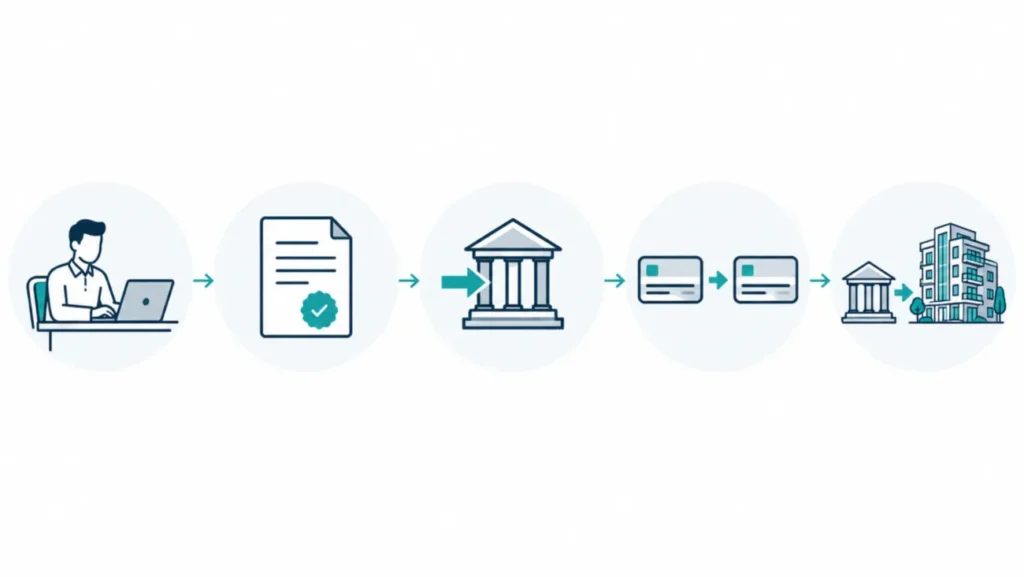
Let’s consider a typical sequence of events. A person has sold a flat in another country: the buyer transferred the money to their account at a foreign bank. Part of the sum was then transferred to another of their own accounts — for example, in a different currency. From there, an international SWIFT transfer was sent to Georgia. To confirm this sequence of events, it is useful to prepare the following documents:
- Sale and purchase agreement and the buyer’s payment confirmation — the first step.
- Bank statement the first statement confirming the outgoing transfer — the second step.
- Statement from the second account, confirming receipt and dispatch to Georgia, — the third link.
- Confirmation of an international transfer (SWIFT message, payment order with a payment reference) — the final step before the funds are credited.
Several common situations deserve special attention. When currency conversion The amount shown on the statements will differ from the original figure: the bank takes this into account, but it is best to explain the difference in advance. If the money was received in several instalments, each of them must be traceable. When using interim accounts (for example, a brokerage account or e-wallet), another document is added to the chain.
A fundamental difference: transfer from your account и payment by a third party — these are different situations from a compliance perspective. If the money is sent not by the customer themselves, but by another person or company, the bank will want to understand the nature of that relationship and the source of the funds from the payer.
To illustrate: if a customer transfers $80,000 to a Georgian bank, this is a hypothetical amount that does not constitute a regulatory threshold for verification. The bank may request documentation for amounts both lower and higher than this, depending on the specific customer profile and the nature of the transaction.
Key Principle: Unexplained gaps in the documentary history of the money may give rise to further enquiries from the bank. The chain of events from the original source of income or event (sale, inheritance, savings) to the point at which the money was ready for transfer must be consistently substantiated by documentation.
Verification of non-residents in Georgia
Banks apply the same KYC requirements to foreign customers as they do to residents. Non-resident status is taken into account in the overall risk assessment alongside the country of residence, the nature of the business, the purpose of the account and other factors — and does not in itself necessitate the application of enhanced measures.
Bank of Georgia and TBC Bank are major commercial banks in Georgia. It is not appropriate to compare the strictness of their internal policies: requirements vary depending on the type of account, the customer’s profile and the nature of the transactions.
When dealing with a non-resident, the bank is usually interested in:
- citizenship and tax residency — particularly if the country is on the high-risk list;
- type of activity — an employee, a sole trader, a business owner, a pensioner;
- the regularity and amount of income — to assess the compliance of the planned operations;
- estimated turnover on the account — the bank usually asks you to specify an expected range when you open an account;
- counterparties and countries through which funds flow — particularly in the case of international transfers;
- the purpose of opening an account — purchasing property, holding savings, and making payments to local counterparties;
- economic ties with Georgia — ownership of property, a residence permit, a local business, and regular stays in the country.
For example, a buyer of a flat in Batumi might explain the purpose of the account as follows: payment for the property being purchased, subsequent payments to the management company, and the receipt of rental income. Such an explanation creates a clear financial profile that corresponds to the stated purpose.
The exact period covered by bank statements depends on the transaction and the customer’s circumstances — you should check this with the bank. Requirements regarding the notarisation, apostille and translation of documents, as well as the language of the documents to be submitted, should be checked with the relevant bank: they may even vary depending on the type of document.
Detailed instructions on how to open an account and a list of the basic documents required for non-residents are set out in a separate article: ‘Opening a bank account in Georgia: step-by-step instructions“.
Source of funds for the purchase of property
Buying a flat in Batumi, Tbilisi or Gonio is a process in which a major international transaction intersects with banking compliance requirements. It is best to prepare the documents proving the source of funds in good time — before the scheduled payment date, rather than after the transfer has already been held up for verification.
How to pay for a flat in Georgia: a step-by-step guide
- Identify the source of the funds. Specify the source from which the flat will be paid for: savings, the sale of assets, dividends, a gift or a loan.
- Gather the supporting documents. Prepare contracts, certificates, tax documents and bank statements that explain the source of the funds.
- Select a payment method. Check with the seller or developer whether a direct transfer from a foreign bank is possible, or whether it would be more convenient to use your own account in Georgia.
- Coordinate the transaction with the banks. Before sending a large sum, check with the sender and recipient to confirm that the payment can be processed, as well as the payment details, currency and any additional documents that may be required.
- Check the terms of the contract. Verify the payee, the amount, the currency, the payment deadlines, the procedure for confirming payment and the consequences of any bank delays.
- Make the payment. Specify the payment reference in accordance with the contract and keep the bank receipt.
- Check that the payment has been credited. Obtain confirmation from the seller that the required amount has been received. The payment order itself does not always prove that the payment has been definitively credited.
- Complete the transaction. Act in accordance with the contract and the applicable procedures for registering title.
A preliminary check of the documents by the bank does not guarantee that the payment will be made. The terms of the transfer and whether it can be carried out may change before the funds are actually credited.
The sender’s bank and the recipient’s bank operate independently and may raise queries simultaneously. The sender’s bank checks whether the transaction is consistent with the customer’s profile and the legislation of the country in which it is registered. The Georgian recipient bank applies its own AML procedures and may request additional documents even after the transfer has already been accepted for processing.
The flow of money matters. Transfer to your own Georgian account gives the buyer more control: the money is paid into an account they control, and from there they can pay the seller. When a direct transfer to the seller from a foreign bank The process is shorter, but the payment reference must clearly state which transaction the payment relates to. When making a transfer to the developer It is important to check the details against the contract and ensure that the contract number and the property are specified in the payment reference.
In which currency should I pay for the flat?
When purchasing property in Georgia, it is important to distinguish between the currency in which the property’s price is stated, the currency of the contract and the currency of the actual payment. The Georgian lari is legal tender within the country, although the law provides for certain exceptions and special rules. Therefore, the acceptable currency for settlement should be clarified in relation to the specific transaction.
Before making the transfer, agree with the seller and the bank on the currency of payment, the recipient’s details, the exchange rate to be applied and the method for determining the final amount. If the money is transferred in a foreign currency and subsequently converted, you must take into account the difference between the National Bank’s official exchange rate and the bank’s commercial exchange rate.
You can compare the exchange terms via the official website of the National Bank of Georgia.
Which payment method should I choose?
| Method | Advantages | What to consider |
|---|---|---|
| Direct transfer to the seller from a foreign bank | No interim transfer to your own Georgian account is required | Bank verification, account details, fees, confirmation of payment |
| Transfer to your own account in Georgia | It’s easier to keep track of your balance and upcoming payments | Opening an account is not guaranteed; incoming and outgoing transfers may be subject to checks |
| Payment to the developer in several instalments | Payments can be spread out according to the agreed schedule | Each tranche can be checked separately |
| A payment from a relative or a company | Possible provided there is a valid legal basis | Banks may request information about the payer and the source of their funds |
| Payment using borrowed funds | Enables the use of the funding provided for in the contract | Documents relating to a loan or credit facility will be required; the terms and conditions depend on the lender and the transaction |
The choice of payment method should be agreed with the banks involved and the seller before the payment is due. No method guarantees that there will be no AML checks.
Residential complexes in Georgia


 Batumi, Bagrationi district
 from 36.69 m²





How much does an international money transfer to Georgia cost?
Transfer costs may include the sending bank’s fee, deductions by intermediary banks, the receiving bank’s fee and currency conversion losses. The final amount depends on the banks chosen, the currency, the route and the payment terms.
The National Bank of Georgia provides an official service for comparing commercial bank fees. The National Bank of Georgia’s official service lists the fee for a standard outbound international SWIFT transfer in US dollars for specific banks and services as 0.2% of the amount, with a minimum of 15 and a maximum of 500 USD. This is an example of specific fee terms and does not represent the cost of any international transfer to Georgia. When receiving money from abroad, you must check the fees charged by the sender, intermediary banks and the recipient’s bank separately.
Before transferring funds, you should check the current fee charged by the specific bank, any deductions made by intermediaries, and the amount that should be received by the seller.
At payment in several instalments — a common practice when buying from a developer — each payment must comply with the schedule set out in the contract. It is advisable to prepare the main set of documents proving the source of funds in advance. However, each subsequent payment may require additional verification, updated statements or further explanations, even if previous instalments have been successfully processed.
Payment involving a third party — where a relative, spouse, another individual or a company is paying on behalf of the buyer — requires a separate explanation. The bank may request documents confirming the basis for the payment, the relationship between the payer and the buyer, and the source of the payer’s funds. The specific documents required depend on the particular contractual arrangement and the requirements of the banks involved: these may include a gift deed, confirmation of the payer’s authority, or another document explaining the basis for the payment.
A key point that is often overlooked: A flat sale and purchase agreement explains what the money is spent on, but does not explain where the buyer obtained it from. During the verification process, the bank may assess the purpose of the payment and the source of the funds separately. State registration of ownership and the bank’s verification of the source of funds are separate procedures with different legal bases. Successful registration of the property does not guarantee that the bank will approve the relevant payment.
Documents required when paying for a property
| Payment method | Transaction documents | Possible additional evidence | Principal risk |
|---|---|---|---|
| Buying from a property developer | A preliminary agreement or other contract with the developer in accordance with Georgian law, payment schedule | Documents relating to the developer’s registration, building permit | Discrepancy between the amount stated in the contract and the actual transfer |
| Purchase on the secondary market | Contract of sale, extract from the register relating to the property | Valuation report for a non-standard price | Discrepancy between the market value of the property and the declared amount |
| Payment via your own account in Georgia | Contract of sale, payment order | Documents relating to the opening of an account, proof of the source of funds | Delay in crediting funds for an international transfer |
| Transfer to a seller from a foreign bank | Contract containing the seller’s details, proof of payment | Payment reference linked to a contract | Blocking of a transfer by a correspondent bank |
| Payment in several instalments | Payment schedule as set out in the contract, confirmation of each transfer | Originals of previous payment notices | Additional verification of related payments and their compliance with the terms of the contract |
| Payment via a relative or a third party | A contract of sale: a document setting out the basis for payment and the relationship between the parties | Verification of the payer’s source of funds | The need to explain the source of funds held by a third party |
What should be included in the contract in the event that the bank delays the transfer?
The bank’s verification process may take longer than the buyer anticipated when the transaction was agreed. It is therefore advisable to discuss separately with the seller, before signing the contract, what steps should be taken in the event of a delay in an international payment.
It is advisable to agree on the following in the contract:
- the point at which a payment is deemed to have been made: the sending of the payment order or the actual receipt of the funds;
- payment confirmation procedure;
- the implications of bank charges;
- the option to amend the payment deadline by written agreement;
- the actions to be taken by the parties if the bank refuses to process the payment;
- the consequences of late payment, the terms for refunding an advance payment, and what happens to the deposit.
The terms and conditions regarding extensions to deadlines and refunds must be agreed between the parties and comply with applicable legislation. The mere fact that a bank check has been carried out does not automatically exempt the buyer from liability for late payment.
Arranging a payment involves understanding how money transfers to Georgia work: for more details, see the article ‘How to transfer money to Georgia to buy property“. The full procedure for a foreigner to purchase property is set out in a separate guide”How to buy property in Georgia“.

Are you planning to buy a flat in Georgia? When choosing a property, it is worth taking into account not only the price and the area, but also the payment terms, the payment schedule and the documents relating to the transaction. Find a property with The Residence.
Complex sources of funding
In the case of cash deposits, family remittances, transactions involving virtual assets and other complex sources of funds, the bank may request additional documents confirming the basis for receiving the money and its transaction history.
Cash and family remittances
Cash is the most difficult to incorporate into the chain of documentation. The bank cannot see its movements through accounts — only the fact that it has been deposited. Bringing cash across the border with a customs declaration merely confirms that the banknotes were declared when crossing the border — but not how the money was earned or obtained. These are two different matters, and a declaration is not sufficient to answer the second question. If cash has been held outside the banking system for a long time, the bank may ask where it originally came from.
How much cash can you bring into Georgia?
When carrying cash, cheques and certain securities across the Georgian customs border, with a total value exceeding 30,000 GEL or the equivalent in foreign currency, declaration is mandatory.
When clearing cash and securities subject to declaration through customs, you may be required to provide documents confirming their origin and intended use. It is therefore advisable to prepare, before travelling, not only details of the amount but also documents explaining the source of the money.
Declaration does not constitute proof of the lawful origin of the money. When cash is subsequently deposited into a bank account, the bank may separately request documentation showing how the funds were obtained.
Before travelling, you should check the current customs regulations in both Georgia and the country from which you are taking money. Restrictions and declaration requirements may vary.
Family transfers and gifts are a common practice, particularly amongst buyers whose parents or spouses are helping them to pay for a property. The bank may request documentation confirming the reason for the transfer of funds. Furthermore, it may enquire about the source of the funds from the donor themselves — especially if the sum involved is substantial. The mere fact of a family relationship and the donor’s good will are not enough.
At the mixed origin of the sum — Salary over several years, plus a gift, plus the sale of property — each component must be documented and you must explain how they add up to the final sum. Attempting to present everything as a single lump sum ‘from various sources’ without providing specific details usually raises further questions.
Cryptocurrency and other assets
Whether funds received from transactions involving virtual assets can be credited depends on the policy of the specific bank and the circumstances of the transaction. Before converting and transferring funds, you should check with the bank regarding its requirements for confirming the history of the acquisition, ownership and sale of assets, as well as for documents from the exchange or other service provider.
The bank may request details of the history of purchases and sales of virtual assets, their conversion and the subsequent movement of funds. Depending on the bank’s policy and risk assessment, this may include a history of transactions on the exchange, confirmation of the user’s identity on the platform, and a statement of conversions.
Sanctions monitoring is carried out alongside AML/KYC and constitutes a separate area of banking compliance. The applicability of restrictions depends on the specific sanctions regime, the parties to the transaction, the banks involved and the transfer route. If the customer or their counterparties are subject to international sanctions, or if the transfer route passes through jurisdictions with restrictions, the transaction may be blocked regardless of whether all other documents are in order.
Complex situations regarding the origin of funds
| The situation | Why do questions arise? | How to prepare |
|---|---|---|
| Long-term cash savings | There is no bank record of how the amount was calculated | Prepare documents detailing the source of income for the accumulation period |
| Family gift | The bank does not know the source of the donor’s funds | Deed of gift + documents showing the donor’s income |
| Cryptocurrency | In order to assess the source of funds, the bank may require a more detailed transaction history relating to virtual assets and documentary evidence of their conversion | Check with the bank in advance to confirm that the funds can be credited; prepare a transaction history from the platform and the conversion documents |
| Money from several accounts | Transfers between several of the client’s own accounts require the transactions to be reconciled and confirmation that the accounts belong to the client | Statements for each account, showing the source of each payment received |
| Translation by a legal entity | The nature of the payment to an individual is unclear | Contract, payment authorisation, documents relating to dealings with the company |
| Income from a country subject to restrictions | Increased jurisdictional risk; potential sanctions issues | Consultation with a lawyer or compliance specialist prior to translation |
Important warning: Formally splitting payments and deliberately complicating the route taken by the money do not replace legitimate proof of their origin, nor do they reduce the likelihood of scrutiny — on the contrary, they may actually increase it. The bank assesses the overall picture as a whole, rather than each individual transfer separately.
If the bank has requested further documents
Receiving a request from the compliance department does not mean you are under suspicion. It is a standard operating procedure whereby the bank verifies the information required to make a decision. A supplementary request does not in itself constitute an accusation and does not imply a refusal.
There are three fundamentally different scenarios, and the course of action in each one varies.
Firstly: the bank requested additional documents before carrying out the transaction. In this case, the documents can be prepared before the funds are transferred, which helps to avoid some of the risks associated with delays in a transfer that has already been initiated. It is important to check with the bank for the exact list of required documents, rather than simply submitting whatever you have to hand.
Second: the transfer is currently being verified; the credit has been delayed. The money has been sent but has not yet been credited to the recipient’s account. In this case, you should contact the sending bank to check the current status of the payment and find out what steps the sender or recipient needs to take. Timeframes in such situations vary and depend on the parties involved.
How can I find out where an international transfer is?
If the sender’s bank has confirmed that the payment order has been processed but the recipient has not received the funds, ask the bank for the UETR (Unique End-to-End Transaction Reference) and any available proof of dispatch.
The UETR is a unique identifier for international payments, enabling banks to track their progress through SWIFT. It consists of 36 characters and is used in the relevant payment messages.
Procedure:
- Ask the sending bank for confirmation that the payment has been processed and for its UETR.
- Please ask them to check the current status of the transfer and whether there are any enquiries from intermediary banks.
- Please provide the recipient or their bank with the necessary details and the reference number for tracing the payment.
- If a transfer has been rejected or returned, please enquire about the reason, within the limits of the information the bank is authorised to disclose, and the procedure for a refund.
- Before resubmitting the payment, please find out exactly what prevented the previous payment from going through.
UETR helps you track international transfers, but does not replace the bank’s AML checks and does not guarantee that the funds will be credited.
Third: the bank has declined the transaction or has given notice of the termination of the account. This is the most complex situation. By law, the bank is entitled not to disclose some of the reasons. If the bank refuses to provide the service, the customer may seek clarification on the available information regarding the decision and make use of the bank’s complaints procedure. If the matter remains unresolved, contact the consumer protection department. of the National Bank of Georgia. According to the procedure published by the National Bank of Georgia, a financial institution is obliged to consider a customer’s complaint and provide a response within one month. This timeframe does not guarantee that the dispute will be resolved in the customer’s favour or that the National Bank’s consideration of an individual complaint will be concluded. Lodging a complaint does not guarantee that a refusal, made on lawful grounds, will be overturned.
A practical step-by-step guide for any of these scenarios:
- Check with the bank for the exact list of missing information or documents.
- Please contact the bank exclusively through official channels — via your online account, the official email address or a branch.
- Prepare all supporting documents that address the specific gap in the documentary chain.
- If there are any discrepancies in the documents (different amounts due to currency conversion, a change of name, or variations in spelling), please provide a written explanation.
- Check the current status of the payment with the sending bank and the receiving bank.
- If necessary, seek legal or tax advice, particularly if the situation involves a complex source of funds or issues relating to sanctions.
You should not assume that submitting the documents will automatically lead to a favourable decision or the account being unblocked within a specific timeframe. The bank makes its own decision.
How to prepare for a bank audit
Documents prepared in advance help to reduce the risk of delays caused by incomplete information, but do not rule out the possibility of additional checks or rejection. It is not advisable to tie the date of a large advance payment to unrealistic deadlines: if the bank requests documents, it may take several days or weeks to gather them, whilst the deadline for the transaction is fast approaching.
A practical checklist for preparation:
- Identify the original source of capital — salary, business, the sale of property, inheritance, a gift, or a combination of these.
- Gather the documents supporting the reason for receiving the money — a contract, decision, certificate or statement confirming entitlement to the sum.
- Prepare statements showing the movements in the account balance — from the source to the account from which the transfer will be made.
- Check that the names, dates and details match In all documents: discrepancies in the spelling of a name or differences in dates often give rise to further queries.
- Determine the purpose and route of the transfer — to your own Georgian account or directly to the seller, in a single payment or in instalments.
- Check with the bank regarding the document format requirements — Do I need an apostille, a certified translation or a notarised document?
- Align the timing of the banking transaction with the timing of the transaction — set aside a margin for verification.
- Retain the originals and secure electronic copies all key documents.
To illustrate what a neutral explanation of the origin of funds might look like: ‘The amount to be transferred consists of salary savings accrued between [year] and [year] (as evidenced by the employment contract, employer’s statements and bank statements), as well as from the proceeds of the sale of a flat in [country] in [year] (as evidenced by the sale and purchase agreement and the credit note).” This is not a ready-made template for a bank – each bank formulates its request in its own way – but it is precisely this structure of the explanation that is clear and convenient for a compliance specialist.
The main rule for preparation: It is advisable to prepare the key documents regarding the source of funds before entering into contractual obligations with fixed payment deadlines. This will help to identify any potential gaps in advance and agree the payment arrangements with the bank.

Are you planning to buy a flat in Georgia? We’ll find properties to suit your budget, chosen city and preferred payment plan. Answer a few questions and receive a personalised selection of properties.
What is important to bear in mind before translating
Preparing documentation regarding the source of funds is an independent and integral part of planning any major international financial transaction. This is particularly true in the case of property purchases, where payment deadlines are set out in the contract and cannot always be postponed.
Three factors that really do influence the outcome: transparency of the source of capital — the bank must be able to trace the entire history of the funds’ origin; sequence of documentary evidence — the chain from the source to the Georgian account must not contain any unexplained gaps; clarifying the bank’s terms and conditions in advance — It is best to find out a particular credit institution’s requirements regarding the format, deadline and content of the documents before sending the money, rather than afterwards.
The Residence works with property buyers in Batumi, Tbilisi, Gonio and other locations across Georgia, helping them navigate the process of selecting a property and finalising the transaction — insofar as this falls within the agency’s remit. Matters relating to banking compliance, tax residency and legal support are handled in collaboration with specialists in the relevant fields.
This document sets out the general rules as at October 2026 and is not a substitute for individual advice from a bank, solicitor or tax adviser. Please check the current requirements directly with the bank and relevant advisers. The National Bank of Georgia’s supervisory policy regarding AML/CFT is set out in in the regulator’s official documents.
 Property in Montenegro
 Property in Cyprus
 Real estate in UAE
 Property in Bali
 Property in Thailand
 Property in Spain
 Property in Saudi Arabia
 Property in Turkey
 Property in Zanzibar
 +995 551 50 18 84
 hello@residence-estate.ge
 Georgia, Batumi, Sherif Khimshiashvili str. 1, office 1204



 Get catalogue of TOP-7 objects