
 +995 551 50 18 84




If you hold savings in USDT, BTC or ETH and are considering buying a flat in Batumi, Tbilisi or Gonio, you’ll most likely have one key question: is it even possible to buy property using cryptocurrency, and how exactly does this work from a legal perspective? The short answer is: It is possible to buy property using funds obtained from the lawful exchange of cryptocurrency. Paying for a flat directly with a virtual asset is a different matter: direct payments using virtual assets are prohibited under the general provisions of Georgian law, and the advertising slogan ‘we accept USDT’ does not mean that this restriction has been lifted.
The gap between a marketing promise and what is actually permitted by law is one of the main sources of risk for the buyer. In this article, we will examine how the legal process works: from selecting a property to registering ownership in Georgia’s public register; we will look at what documents are required to prove the source of funds, how much the whole process will cost, and where the main pitfalls lie.
Is it legal to make a purchase using cryptocurrency?
To avoid confusion over terminology, it is important to distinguish between three different operations from the outset: ownership of a crypto-asset, exchanging it for fiat currency и payment for property. Lumping them together under the single phrase ‘buying a flat with Bitcoin’ may be convenient for an advertising headline, but it is inaccurate from a legal point of view.
The National Bank of Georgia (NBG) has made its position clear: Virtual assets are not legal tender in the country. Article 39¹(2) of the Organic Law on the National Bank of Georgia prohibits payments made using virtual assets. According to the regulator’s official FAQ, exceptions to this ban apply to transactions necessary for the provision of the services themselves involving virtual assets — and do not constitute a general authorisation to pay for a flat using USDT or BTC. A standard property sale, where the buyer transfers tokens directly to the seller, does not fall under these exceptions.
Why, then, are there so many adverts for ‘flats for USDT’? If an estate agent or developer says they accept tokens, ask for a written breakdown of the payment arrangements before transferring any funds: who receives the tokens, who transfers the money to the seller, and via what arrangement. Such wording may conceal an arrangement where the exchange is handled by an intermediary, after which the actual payment under the contract is made in fiat currency. These are fundamentally different matters.
Buying property with funds from cryptocurrency trading and paying for a flat directly in cryptocurrency are legally distinct transactions.
The intermediaries through which the conversion takes place are known as VASPs — Virtual Asset Service Providers, virtual asset service providers. In Georgia, they are subject to registration and supervision by the NBG. The VASP Register and the list of activities authorised for them published on the regulator’s website. This is of fundamental importance: not every exchange that accepts USDT is a registered VASP with full authorisation. Furthermore, VASP registration does not equate to a blanket authorisation to handle the entire payment process independently — the specific list of authorised services must be checked.
What does this mean for the buyer? Cryptocurrency may be the original source of funds for a property transaction, but the mere fact that BTC or ETH is held in a wallet does not mean that any method of using them in a transaction is lawful. The recommended approach: cryptocurrency → regulated provider → fiat currency; settlement and registration of rights — in accordance with the procedure set out in the contract and applicable requirements — This is precisely what a legally permissible arrangement looks like. Transferring tokens directly to the seller without going through this arrangement contravenes the general principle of the law.
Cryptocurrency trading does not, however, exempt users from standard financial requirements. AML (Anti-Money Laundering — combating money laundering) and KYC (Know Your Customer — customer identification) applies to both VASPs and the banks involved in subsequent settlements. This means requests for documentation, verification of the source of funds and possible delays — even if the exchange itself went smoothly from a technical point of view.
The requirements for providers continue to evolve. On 1 January 2026, the following came into force an amendment requiring VASPs to provide customers with access to the registration certificate. On 10 March 2026, NBG announced that it was drafting regulations governing the initial offering of stable virtual assets — This announcement relates to a specific new tool, rather than a general authorisation for the direct payment of property prices using tokens. Before selecting a provider, please check the current version of the NBG’s requirements and the latest information regarding the provider’s registration.
How to carry out the calculations
In practice, there are several ways to use cryptocurrency to pay for property. Each has its own terms and conditions, restrictions and documentation requirements.
A separate issue that is often overlooked: settlement currency. The contract must specify the currency of the price, the acceptable currency for payment and the conversion procedure separately. The option to settle in USD or EUR depends on the parties involved, the banking route and any applicable exemptions from the lari regulations – the mere fact of exchanging a crypto-asset for a foreign currency does not resolve this issue.
Payment methods when buying property
| Method | How the operation is carried out | Advantages | Limitations and risks | What to check in advance |
|---|---|---|---|---|
| Conversion via a registered VASP, payment from your own bank account | The buyer sells cryptocurrency via a VASP, receives fiat currency into their account, and transfers it to the seller as per the contract | A clear chain of documentation, a standard bank transfer | A bank account is required, as well as completion of KYC procedures with the VASP and the bank; you may be asked to provide documents | VASP status in the NBG register, the services it is authorised to provide, fees and the total amount due |
| Channelling fiat funds into an authorised payment scheme via a VASP | At the client’s request, a VASP may transfer funds from the exchange to a participating payment service provider, intermediary or acquirer, including a sub-acquirer | Fewer steps for the customer | Applicability depends on the specific services offered by the provider and the legal status of all parties involved in the chain; please check the contractual basis for each payment | Is this service authorised for this VASP; what is the role of each party and the procedure for the transfer of fiat currency to the seller; does the seller’s bank consent to such a transfer? |
| Dispensing of fiat cash following an exchange, subsequent settlement | The VASP dispenses cash, and the customer pays in accordance with the terms of the contract | This is possible in a number of situations | Cash payments are subject to specific legal and documentation requirements; bank transactions are less traceable | Is such a calculation permissible under the terms of the contract and Georgian law for this amount? |
| Direct BTC/USDT transfer to the seller | The tokens are sent directly to the seller’s crypto wallet | - | Prohibited by the general rule: Section 39¹(2) of the Organic Law on the National Bank of Georgia. Compliance with KYC requirements does not override this prohibition. Ownership does not arise from the mere fact of a blockchain transaction | Requires a separate legal assessment; is not a standard method of payment |
An important practical conclusion should be drawn from the table: choosing a specific route It depends on who the buyer is (a resident or a non-resident), how the transaction is structured, which bank the account is held with, which specific VASP is involved, and what range of services it is authorised to provide. The same method may be available at one bank but not at another — it is worth agreeing on this in advance, rather than after the assets have been transferred.
How The Residence helps with cryptocurrency transfers
We have a partner company that specialises in cryptocurrency translation and exchange. The Residence helps to find suitable properties and coordinate the financial aspects of the transaction between the buyer, the seller and our partner.
Before translating, you need to determine:
- which asset and network are used;
- who accepts cryptocurrency and carries out exchanges;
- how much fiat will the recipient receive after expenses;
- what documents are required;
- as agreed regarding the dates for the exchange, payment and registration.
We assist with the selection and coordination of purchases. The relevant participant in the agreed scheme carries out the transfer and exchange. Assets, networks, fees and documents are verified prior to the transaction. The involvement of a partner does not exempt the transaction from bank checks.
Select a property and discuss the payment arrangements
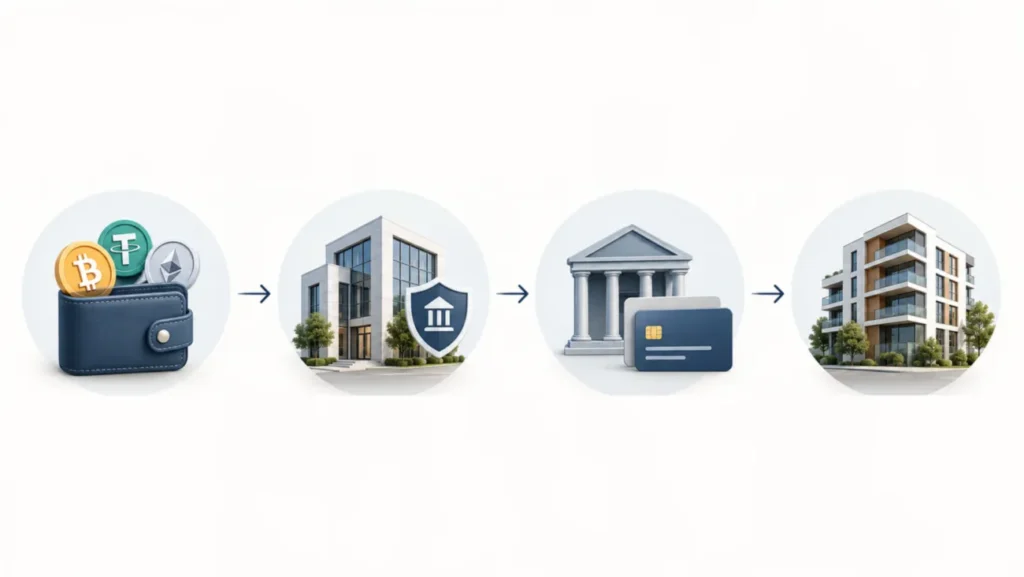
For more information on bank transfers in property transactions, see the article ‘How to transfer money to Georgia to buy property’.
Step-by-step guide to purchasing
This is the most important section in practical terms. Below are the seven stages involved in preparing for and finalising a purchase. The procedure for payment, submission of documents and registration of title is agreed upon for each specific transaction; the numbering of the stages does not imply that full payment is required prior to registration.

1. Setting a budget and selecting a property
Start with a realistic calculation: the cost of the property plus all associated expenses — currency conversion, bank charges, registration and legal support where necessary. It is best to set the budget in fiat currency, as this is the currency in which the contract price will be stated. The volatility of BTC and ETH means that the amount ‘in crypto’ is only a guide until the time of exchange.
2. Verification of the owner, the property or the developer
Before entering into any discussions about payment, check what is being sold and by whom. For the secondary market: a current extract from the National Agency for the Public Register (NAPR) will show the owner, whether there is a mortgage, a seizure order or any other encumbrances. For new-build properties: check the specific purchase agreement for the property under construction – the subject matter, title to the land, planning permission, timelines, the handover procedure and the refund terms. For more details, see the article ‘How to check a property in Georgia before buying’.
3. Selecting an adjustable conversion method and agreeing this with the bank
You can arrange the conversion process yourself or discuss it with The Residence. Before transferring the assets, ascertain which party is carrying out the exchange, check their legal status and agree on the route for the fiat funds. If a VASP registered in Georgia is being used, check its details in the NBG register. At the same time, check with the bank regarding the necessary documents and the conditions for accepting the transfer. A preliminary discussion does not guarantee that a specific transaction will be credited.
4. Preparation of documents and verification of the source of funds
You need to gather the necessary documents in advance: a history of your trading activity on the exchange, proof of cryptocurrency purchases, wallet statements and tax returns, if applicable. The longer and more complex the history of an asset, the more questions may arise. For guidance on how to put together the correct set of documents, see the article ‘Proof of the origin of funds in Georgia’.
5. Agreement on the contract, the currency of the price, and the terms and conditions of payment
To purchase property in Georgia, a written contract and registration of the title in the public register are required. Signatures are certified in accordance with the procedure laid down by law; no separate notarisation is required when signing in the presence of an authorised official of the registration authority. Prior to signing Agree on: the currency of the price and the acceptable currency for payment, the payment deadline, the allocation of currency risk, liability for late payment, and the procedure for refunds should the transaction fall through. If the cryptocurrency exchange rate changes from expectations by the time of the exchange, the allocation of this risk must be set out in the contract. Details on the structure of the contract can be found in ‘Contract for the Sale and Purchase of Property in Georgia’.
6. Cryptocurrency exchange and the processing of a documented fiat payment
This is an irreversible step. Only after once all the previous stages have been completed: the property has been inspected, the contract has been agreed, the bank has confirmed the terms of the transfer, and the VASP has confirmed the transaction details. After the exchange, keep all confirmations: the transaction receipt from the VASP, the payment order, and the bank statement showing the payment details. These documents confirm the exchange and the subsequent movement of funds. Keep them together with the documents relating to the original source of capital; the bank or VASP will assess whether the entire package is sufficient.
7. Registration of ownership, obtaining a certificate and retaining supporting documents
Ownership rights in Georgia arise from the moment registration with NAPR (Article 183 of the Civil Code of Georgia) — not from the moment the contract is signed, nor from the moment the money is transferred. The application for registration must be submitted in person or through a representative acting under a power of attorney. Timeframes and fees are set out in the section on costs. Once registration is complete, you will receive a certificate and should keep a complete set of documents relating to the transaction: the contract, proof of payment, currency exchange documents and the registration receipt.
What to check before a transfer
Before sending cryptocurrency for conversion, please go through the checklist:
- The salesperson’s personality has been confirmed; his right to dispose of the asset and the contractual basis for each payee have been verified. If the money is to be paid to a creditor or another party, this must be agreed in the contract and verified by a solicitor.
- Network and address They have been independently verified for cryptocurrency transfers — not just based on information from messaging apps or email.
- Exchange rate and the period for which it is fixed — Check with the VASP whether a fixed rate is available, for how long and under what terms, and set this out in writing.
- Committees calculated in advance — the total amount of fiat to be received, taking all expenses into account.
- Payment reference The bank transfer is in accordance with the contract.
- Returns Policy is stipulated in the event of a failed transaction.
- Papers Depending on the source of the funds, they are ready to be presented on first request.
Documents and verification of funds
There is no single, mandatory set of documents that applies to everyone. The scope of the documents required depends on the transaction amount, the risk assessment carried out by a specific VASP or bank, the buyer’s country of origin and the history of their assets. Nevertheless, it is possible to outline standard and extended sets of documents.
The VASP and the bank carry out customer identification and may request proof of address and documents confirming the source of funds. The exact list and acceptable formats of documents depend on the specific provider, bank and transaction amount — please check with the parties involved in your chosen route. In the event of an in-depth verification, the following may also be required:
- transaction history on the exchange or from the wallet during the period of asset ownership;
- documents confirming the circumstances under which the crypto-asset was acquired — for example, purchase on an exchange or mining; if the asset was received as a reward, check separately the legality of the underlying transaction, taking into account the applicable jurisdiction and date — the mere existence of documents does not in itself rule out a possible breach;
- tax returns or other financial documentation from the country of residence;
- bank statements showing the movement of funds prior to the acquisition of the crypto-asset;
- contracts or other documents, if the cryptocurrency was obtained as a result of commercial activities.
What documents might you need?
| Document | Who can apply | Which confirms | What to do if it’s not there |
|---|---|---|---|
| Passport / identity card | VASP, bank, notary, NAPR | The buyer’s profile | Without him, the deal cannot go ahead |
| Proof of address | VASP, bank | Registered address; tax residency is determined separately | Utility bill, bank statement showing your address |
| Transaction history on the exchange / from the wallet | VASP, bank | Shows the operations at the relevant site; the source of the initial capital is verified separately | Request an official report from the stock exchange |
| Proof of the source of the fiat funds used to purchase the cryptocurrency | VASP, bank (subject to in-depth verification) | The Origin of Initial Capital | Bank statements, contracts for the sale of assets |
| Confirmation of the exchange from the VASP | The bank, or the seller if necessary | Confirms the fact, amount and terms of the exchange; the source of the original funds is verified separately | You must obtain the following from the VASP at the time of the transaction |
| Confirmation of payment under the contract | Notary, seller | Facts and terms of payment under the contract | Please keep the payment documents relating to the transfer to the seller; the document confirming the credit to the buyer’s account only confirms this stage |
| Documents relating to the property (NAPR extract, cadastral, building and technical documents) | The buyer, the notary | A NAPR extract shows the registered rights and restrictions; technical documents are required to verify that these correspond to the property’s actual condition | Check via NAPR and ask the seller for the supporting documents |
One point that is often overlooked: transaction hash — its identifier. You should use it to check the transaction status, addresses, asset, amount and any necessary confirmations on the relevant blockchain. The hash itself does not confirm the successful transfer of tokens, does not prove the legitimacy of the funds’ origin, does not constitute performance of a contract, and does not give rise to ownership rights over property. When carrying out checks, a bank or VASP looks not only at the fact of the transfer, but also at the entire chain — where these assets originally came from.
Charges and fees
The total transaction amount comprises several items, and it is important not to overlook any of them when planning the budget.
Key components:
- Property value — the contract price in the agreed currency.
- Deviation of the client’s exchange rate from the market benchmark — the difference between the VASP exchange rate and the market price of the asset at the time of the transaction. The exchange cost depends on the provider, the asset, the network and the transaction amount; ask for the total fiat amount you will receive, taking all fees into account, rather than the advertised rate.
- VASP Commission — fixed or variable; please check in advance.
- Network commissions (gas fees for ETH, USDT transfer fees) — these depend on the network and its load.
- Bank charges — a fee for an incoming international transfer, and any currency conversion.
- Notarisation — where applicable; the cost depends on the notary you choose.
- Services provided by a solicitor or agent — if they are involved.
- NAPR registration fees: by data from the register, registration of a property title costs 150 GEL within 4 working days, 270 GEL within 1 working day, or 350 GEL on the day of application; an online extract costs 13 GEL within 1 working day or 52 GEL on the day of application.
- Tax liabilities — depend on tax residency, the structure of the transaction and a number of other factors; they are not one-size-fits-all. Please seek advice from a specialist.
Example of a purchase budget
Why 100,000 USDT might not be enough to buy a flat costing 100,000 USD
This is a purely hypothetical example and does not constitute an offer of a specific service. The provider has received 100,000 USDT; the sender’s network fees are paid separately. The acceptable currency for payment to the seller is agreed upon for each transaction.
| Indicator | Conditional value |
|---|---|
| Amount payable to the provider | 100,000 USDT |
| Exchange rate | 0.995 USD per 1 USDT |
| Fiat prior to specific committees | 99,500 USD |
| The provider’s separate commission | 100 USD |
| Bank deduction | 50 USD |
| The recipient will receive | 99,350 USD |
| Still short of 100,000 USD | 650 USD |
Compare the total amount received by the recipient, not just the stated commission. Ask for a quote based on the specific amount and the validity period of the quote. If the commission is already included in the exchange rate, do not add it again.
When comparing exchange offers, it is important to look at the end result: How much fiat will the recipient receive? taking into account all charges levied by the provider, the network and the bank. Two offers with the same advertised rate may yield different results if they differ in terms of the deviation of the customer exchange rate from the market benchmark or the range of additional fees. Ask the VASP for a final calculation for a specific amount, stating the exchange rate at the time of the quote.
Please note: GEL and USD are different currencies. If some of the expenses are in lari and the majority are in dollars, it is incorrect to combine them into a single line without specifying the exchange rate.
How to check the property and the seller
Regardless of the method of payment, ensuring the security of a transaction starts with checking exactly what you are buying and from whom.

Verification via NAPR: You can obtain a current extract from the register online. It will show the registered owner and whether there are any mortgages, seizures, easements or other restrictions. The extract reflects registered rights and restrictions, but does not replace a check of the property’s actual condition, any known disputes and the supporting documents. Check the details in the extract against the seller’s identity and their right to dispose of the property. If a representative is acting on behalf of the seller, check the power of attorney: the scope of authority and its validity period.
Inspection of a new-build property: For projects currently under construction, the following are particularly important: the planning permission, the developer’s title to the land, the track record of previously completed projects, the deadlines set out in the contract, and the penalties for breaching them. For further details, see ‘How to check a property developer in Georgia’.
Contract: Ensure that the payment terms, deadlines, the parties’ liability for late payment and the procedure for refunds in the event of a failed transaction are clearly set out. In transactions involving cryptocurrency payments, it is particularly important to specify: what happens if a transfer is delayed due to a bank verification, what the refund procedure is should the transaction fall through, and how currency risk is allocated.
Risks and verification measures
| A potential problem | How to detect | How to reduce the risk |
|---|---|---|
| Problem title: encumbrance, attachment, mortgage | A current NAPR statement and verification of supporting documents prior to settlement | Do not make the payment until you have received a clear account statement or confirmation that the encumbrance has been lifted; if there is a mortgage, check to whom and in what order part of the funds is to be transferred |
| Substitution of a crypto wallet or payment details in correspondence | Messages with amended details sent on behalf of the counterparty | Verify the recipient’s address via a pre-established independent communication channel; do not rely solely on a messaging service or email |
| A bank’s refusal or delay in accepting a transfer | The bank may request additional documents relating to the transaction | Discuss the route and documentation with the bank before the exchange; allow for a time buffer in the contract deadlines |
| Construction delay / unfinished project | The property’s history, the terms of the contract, and the developer’s reputation | Clear penalty clauses in the contract; payment in instalments where possible |
| Discrepancies between the documents and the actual situation | Site inspection, technical certificate, verification of floor area and specifications | Do not transfer funds until the actual condition has been confirmed and found to be in accordance with the documents; engage an independent technical expert |
Practical example: a buyer is ready to exchange USDT and has already reached an agreement with a VASP. However, a check of their NAPR statement revealed an outstanding mortgage on the flat. The correct sequence — First, clarify the conditions under which the mortgage is discharged and who pays for it, set this out in the contract, and check who the funds are paid to towards the repayment. Only then should irreversible payments be made. Not the other way round.
A blockchain transaction is, as a rule, irreversible. If a transaction fails due to the seller’s fault, getting your money back involves legal proceedings or negotiations. Check the item before making payment, not afterwards.
Where to buy property
The choice of city in Georgia determines the market characteristics and typical usage scenarios. Below is a brief overview for guidance; please compare specific properties and up-to-date data for your chosen segment.

Batumi — a coastal town with a well-developed tourist infrastructure and a wide choice of flats and apartments on both the new-build and secondary markets. Properties are available for both residential and holiday let; for short-term lets, assess seasonality based on the selected segment and specific location.
Tbilisi — a capital city with a diverse range of properties on offer: historic neighbourhoods, new residential developments, and a variety of rental and accommodation options. The market has a more urban character compared to holiday property.
Gonio and Quarati — coastal areas south of Batumi. When choosing a property here, consider the availability of transport and services during the relevant season, the legal status of the plot and the terms of management of the development.
New-build properties in Gonio to suit your budget


 Batumi, Gonio
 from 110 m²





Important: National regulations governing cryptocurrency payments apply uniformly throughout Georgia. There are no municipal or regional exceptions for direct cryptocurrency payments.
Are you looking for a flat in Georgia and planning to pay using cryptocurrency? Take The Residence property search: Please specify your budget, city and the purpose of your purchase so that we can find suitable properties and discuss the payment arrangements in advance.
Risks associated with cryptocurrency transactions
Technical and financial risks overlap in this context, and some of them are specific to cryptocurrency transactions.
Volatility. The value of BTC and ETH can fluctuate significantly over the course of a few days. If the price in the contract is fixed in US dollars and you plan to sell BTC, the difference between today’s exchange rate and the rate on the conversion date will be borne by the party specified in the contract. Check with the VASP to see if exchange rate fixing is available, for how long and under what conditions. Stablecoins (USDT, USDC) reduce price risk, but they come with their own risks: dependence on the issuer, the risk of deviation from the target rate, and regulatory pressure on a specific token.
Network or address error. USDT is available on several networks, including Ethereum and Tron. Before making a transfer, agree with the recipient on the exact network, token version and, if necessary, the contract address: the sender’s and recipient’s settings must match. An error in the transfer details may result in the loss of funds. In some cases, recovery may be possible with the assistance of the platform or the issuer, but this is not guaranteed and may incur a fee — please check the full address and details before confirming.
Falsification of details. A possible scam involves the falsification of a wallet address or bank details in correspondence.
Check the payment details via a pre-arranged, independent communication channel, not just a messaging app or email. Changing a single character in the address or altering the instructions in an email could result in the irretrievable loss of funds.
Transaction irreversibility. A confirmed blockchain transaction cannot, as a rule, be reversed at the sender’s initiative. A refund requires a separate transaction or the use of available legal or technical procedures; the outcome is not guaranteed.
Compliance checks and delays. Even a legitimate transaction may be delayed due to a request for additional documents from the bank or a VASP. If the contract specifies a strict payment deadline, such a delay may have legal consequences. Build in a time buffer and set out the procedure to follow in the event of a delay directly in the contract.
Fraudulent intermediaries. Not every exchange or ‘broker’ promising to carry out a transaction is a registered VASP. Check the NBG register before transferring funds.
Tax uncertainty. The purchase of property and prior transactions involving crypto-assets require a separate tax assessment. The outcome depends on the individual’s status, the type of income, the source of funds and the applicable agreements. Tax implications are assessed under the laws of Georgia and other relevant jurisdictions, including the jurisdiction of tax residence, taking into account applicable international agreements. The method of financing the purchase does not in itself determine whether or not tax is payable. Consult a tax specialist before proceeding with the transaction — particularly where large sums are involved.
Practical measures: Before making any transfer, check the provider against the NBG register; request a final statement showing all charges; keep all receipts; and consult qualified professionals – legal, financial and tax advisers.
Purchase by a foreign national via distance selling
The status of a foreign national and the issue of cryptocurrency transactions are two separate legal matters. The restrictions in each case are independent, and it is important not to confuse nationality with tax residency: these are different statuses with different legal consequences.
Property rights: Foreign citizenship does not, in itself, impose any general restrictions on the purchase of a flat or apartment. When buying a house or a plot of land, it is necessary to check the land category. As a general rule, foreign nationals are not permitted to purchase agricultural land in Georgia. The law provides for certain exceptions, including the acquisition of land by inheritance. Special conditions apply to companies, relating to the structure of control and the grounds specified by law. A Georgian lawyer will verify the category of the plot and whether the exception applies.
Distance contract This can be done via a notarised power of attorney. For a foreign power of attorney, you must check whether an apostille or consular legalisation is required, or whether an exemption under an international treaty applies — this depends on the country of issue. Translation into Georgian and its certification also require approval. The bank meets with the representative separately — please check directly with the bank regarding the actions permitted under the power of attorney. For further details, see ‘How to buy property in Georgia remotely’.
Bank transactions. Having an account with a Georgian bank may be convenient for making payments and subsequent rentals, but whether it is necessary depends on the payment route and the terms of the contract. Simply having an account does not guarantee that funds will be accepted following the exchange of crypto-assets — the bank may still verify the specific transaction.
Greater attention to documents: Depending on the buyer’s jurisdiction, sanctions status, the origin of the funds and the policies of the specific bank, additional checks, restrictions or a refusal to provide the service may apply. The availability of the payment route should be checked before the transaction, not afterwards.
On a separate note — regarding residence permit. Buying property does not in itself automatically entitle you to a residence permit. This is a separate administrative procedure with its own conditions, which change from time to time. Before making any decisions based on this factor, please check the current requirements via official sources.
Real estate for investment in Batumi






What to bear in mind before buying
To successfully purchase property in Georgia using cryptocurrency, three things must be in place simultaneously: a correctly selected object, a fully documented and transparent money trail и proper legal registration of ownership. A weak link in any of these three areas is a source of problems, regardless of how technically sound the cryptocurrency aspect may be.
Before making any payments, inspect the property, agree on the contract and the payment schedule. The procedure and timing for payment, the submission of documents and the registration of title are determined by the terms of the specific transaction. Do not transfer the full amount without an agreed buyer protection mechanism in the event of registration being refused or delayed. Direct payment using virtual assets is prohibited by general law; the promotional headline ‘we accept USDT’ does not override this restriction.
At key stages — such as the conversion of a large sum, tax implications in Georgia and other relevant jurisdictions, and non-standard transaction structures — it is advisable to engage a banking specialist, a tax adviser and a lawyer familiar with Georgian legislation. Banking terms and conditions and compliance requirements are subject to change and must be clarified prior to the transaction, rather than during it.
Scope of the agency’s services The Residence is specified in the contract. Legal and tax valuations should be obtained from relevant specialists, whilst the bank’s terms and conditions should be obtained from the bank providing the service.
 Property in Montenegro
 Property in Cyprus
 Real estate in UAE
 Property in Bali
 Property in Thailand
 Property in Spain
 Property in Saudi Arabia
 Property in Turkey
 Property in Zanzibar
 +995 551 50 18 84
 hello@residence-estate.ge
 Georgia, Batumi, Sherif Khimshiashvili str. 1, office 1204



 Get catalogue of TOP-7 objects