
 +995 551 50 18 84




Georgia does not have a single, universal ‘property tax’ — this term encompasses several different obligations, each of which arises at a specific stage: upon purchase of the property, during the period of ownership, when receiving rental income, and upon sale. The tax burden depends on the owner’s status, the type of property, the family’s total income, the nature of the property’s use and the duration of ownership. For foreign buyers, there is no separate ‘non-resident tax’ based solely on nationality; however, tax status affects the composition of taxable income and may give rise to tax liabilities in two countries simultaneously.
This information has been verified and updated as of August 2026. It is recommended that you check the specific rates and deadlines against the current version. of the Tax Code of Georgia and official documents from the Revenue Service.
Short answer. Buying flats in Georgia In itself, this is not usually subject to a separate tax on the transfer of ownership. Following the purchase, the owner may be liable for annual property tax, land tax, tax on rental income, capital gains tax on the sale of the property and, in certain business contexts, VAT. The specific tax liability depends on the family’s income, the type of property, its use and the duration of ownership. Please refer to the table below for detailed tax rates.
This material is for information purposes only. The tax implications of a specific transaction depend on the owner’s status, the intended use of the property, the composition of the household, the source of income and the actual way in which the property is used.
This is a general overview for individuals. Land tax, commercial leases, short-term lettings, ownership through a company and non-standard transactions are calculated separately.
| The situation | Rate or consumption |
|---|---|
| Purchase of a flat by an individual | There is not usually a separate tax on the transfer of ownership |
| Registration of ownership | 150 GEL within 4 working days, 270 GEL within 1 working day, or 350 GEL on the day of application |
| The household income does not exceed 40,000 GEL | Property, other than land, is exempt from tax where the right to relief applies |
| The household income exceeds 40,000 GEL but is less than 100,000 GEL | 0.05–0.21 TP415T of the market value of the property |
| Household income is 100,000 GEL or more | 0.8–1% of the market value of the property |
| Long-term letting of residential property | 5% from income before deduction of expenses |
| Sale of a residential property before the expiry of the grace period | 5% from the taxable surplus |
| Sale after more than two years of ownership | A tax exemption may be available |
| VAT in business activities | 18%; registration is mandatory if taxable turnover exceeds 100,000 GEL over a continuous 12-month period |
This is a general overview for individuals. Land tax, commercial leases, short-term lettings, ownership through a company and non-standard transactions are calculated separately.
Taxes at different stages of ownership
Before examining individual obligations, it is useful to look at the bigger picture. The table below shows the tax events that may arise at each stage — from the transaction through to the sale.
Table 1. Tax liabilities by stage
| Stage | Contingent liability | When it happens | Tax base | What to check |
|---|---|---|---|---|
| Buying | There is usually no separate tax on the purchase; however, there are registration and associated costs | When finalising a transaction | There is usually no tax base; the registration fee is a fixed amount | Registration period, NAPR tariff, bank charges, transfers and legal support |
| Ownership | Property tax | Provided that the terms of the code are complied with | Market value of the property | Family income and benefits |
| Land ownership | Land tax | In accordance with the rules for that particular site | Area, category, local council rate | Purpose and location |
| Rentals | Income tax, sometimes VAT | Where income is received as income from a source in Georgia | Gross income or another basis under the applicable regime | Type of lease, operational status, parties to the contract |
| For sale | Tax on taxable surplus | In the case of a taxable sale | The difference between income and verified expenditure | Period of ownership and documents |
| Gift or inheritance | Potential income tax | Depending on the relationship and the basis for the transfer | Market value or applicable basis | Degree of kinship and entitlement to benefits |

The state fee for registering ownership is an administrative charge, not a tax. The amount is fixed and does not depend on the value of the property. Notary fees, bank charges, the cost of translating documents and estate agent’s fees are also not tax payments, although they form part of the overall transaction costs. This distinction is important: some acquisition costs may subsequently reduce the taxable gain on sale, provided they are supported by documentation and permitted under the Tax Code — but the composition of such costs must be verified separately.
How much does it cost to register a property?
Under the current fees set by the National Public Register Agency, the registration of the creation, amendment or termination of a right in rem in respect of immovable property costs:
| Registration deadline | State fee |
|---|---|
| 4 working days | 150 GEL |
| 1 working day | 270 GEL |
| On the day the application is submitted | 350 GEL |
The cost of certifying the signatures of the parties to a transaction submitted for registration is 7 GEL. An electronic extract from the register can be obtained for 13 GEL within one working day or for 52 GEL on the day the request was made. A standard statement costs 20 GEL per working day or 75 GEL on the day of the request.
Registration fees are not based on the price of the flat, but are subject to change. You should check them again on the official NAPR website before completing the transaction.
Example of costs involved in buying a flat
The buyer is purchasing a flat for 250,000 GEL and opts for standard registration of title within four working days.
| Consumption | Amount |
|---|---|
| Price of the flat | 250,000 GEL |
| A separate tax on purchases | 0 GEL |
| Registration of ownership | 150 GEL |
| Electronic extract from the register | 13 GEL |
| Verification of the parties’ signatures — if this service is used | 7 GEL |
| Translation of documents | At the translator’s rate |
| Banking Commission | According to the bank’s rates |
| Due diligence | As agreed with the solicitor |
The minimum total for the specified fixed payments is 250,163 GEL, or 250,170 GEL when using the signature verification service.
This is a hypothetical example. The calculation does not include any potential costs relating to a power of attorney, translation, apostille, bank transfer, legal due diligence, cadastral work or agent’s fees.
Once ownership has been registered, the tax obligations do not end; rather, they are only just beginning. A tax liability arises by operation of law where there is taxable property and other specified conditions are met. The owner is responsible for checking their liability, submitting their tax return on time and paying the tax — even if they have not received a personal reminder. If the property is let, there is an obligation to declare the income. If the property is sold in the future, tax may be payable on any taxable capital gain. Planning your budget based solely on the purchase price of the property means underestimating the true cost of ownership.
You can read more about how the transaction works and what happens before the title is registered in the article ‘How to buy property in Georgia’“.
Are you looking for a property in Georgia? Please answer a few questions about your purchase objectives, budget and preferred location — the team at The Residence will put together a suitable selection of properties in Batumi, Tbilisi, Gonio and other regions. Go to the property search
Property tax
Property tax in Georgia is a local tax: its rates are set by local authorities within the ranges specified in the Tax Code (Articles 202–206). This means that two flats in different towns, with the same market value and the same owner’s household income, may be taxed at different rates — depending on the decision of the specific local authority.
An individual’s taxable property includes buildings, parts of buildings and properties under construction. A plot of land is a separate taxable item, which is subject to different rules (see the next section for further details). A flat in a block of flats, a detached house, a suite in an aparthotel, or commercial premises – all these properties are potentially included in the tax base, although the applicability of a specific rate depends on a number of conditions.
The tax base is determined on the basis of the market value of the property in accordance with the requirements of the Tax Code and the applicable valuation rules. The Tax Code does not imply that every owner is obliged to commission a new report from an independent valuer every year. However, the owner must be able to justify the declared market value. If the value of the property has changed significantly, if there are several properties, if the property is commercial, or if the calculation is likely to give rise to a dispute with the tax authorities, it is advisable to obtain a professional valuation or a written explanation from a tax adviser. The price stated in the contract of sale does not automatically equate to the market value on the date the tax is calculated: the market changes, and over the course of several years the tax base may differ significantly from the purchase price.
Rates for individuals
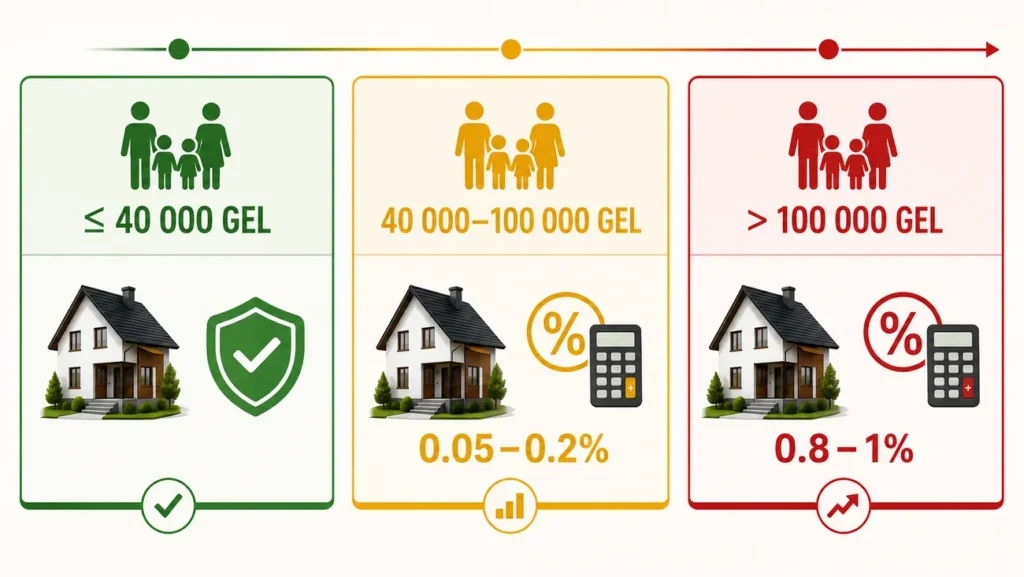
The key factor determining the rate is — total annual household income the taxpayer’s. It is the household income, rather than just the owner’s personal income, that determines whether the owner falls within the tax relief bracket or not.
Table 2. Property tax brackets for individuals
| Annual household income | General principle | Betting range |
|---|---|---|
| Does not exceed 40,000 GEL | Property (other than land) is exempt from tax provided there are no other exclusions from the relief | 0% where entitlement to a concession applies |
| More than 40,000 GEL, but less than 100,000 GEL | The tax is calculated on the basis of the market value of the taxable property | 0.05–0.21 TP415T |
| 100,000 GEL or more | An extended range is used | 0.8–1% |
A few key points that must not be overlooked:
- The exact rate is set by the local authority within the statutory range. The current rate for a specific municipality must be checked against the applicable local by-law.
- Land tax is calculated separately and is not automatically eligible for property tax relief.
- The right to exemption must be assessed in the light of the entire applicable provision — not just the income threshold.
- You cannot simply multiply the purchase price by the maximum rate for 1%: the base is the market value on the relevant date, and the rate depends on income and the local authority.
- Payments and declarations are made in lari (GEL); the currency in which the property was paid for at the time of purchase is irrelevant.
Do you need to pay annual tax? A quick check
- Check whether you own a flat, a house, commercial premises, a property under construction or a plot of land in Georgia.
- Calculate your household’s total income for the year preceding the tax year.
- If the household income does not exceed 40,000 GEL, an individual’s assets, excluding land, are exempt from tax provided they are eligible for the relief.
- If your income exceeds 40,000 GEL, determine the market value of all your taxable assets.
- Check the rate set by the local authority where the property is situated.
- Calculate the provisional tax: the market value of the property × the applicable rate.
- Please check the land plot separately: the family income exemption does not automatically apply to land.
- If you are required to do so, please submit your tax return by 1 November at the latest and pay the tax by 15 November at the latest.
Illustrative calculation examples (preliminary estimate, not a final calculation):
Example 1. An apartment with a market value of 250,000 GEL; the family’s annual income is 70,000 GEL. The family falls within the ‘more than 40,000 but less than 100,000 GEL’ bracket. The applicable municipal rate ranges from 0.05% to 0.2%.
Indicative tax range: 250,000 × 0.0005 = 125 GEL (lower limit) up to 250,000 × 0.002 = 500 GEL (the upper limit of the range).
The exact amount depends on the rate set by the relevant local authority.
Example 2. Flats with a market value of 400,000 GEL and a household income of 100,000 GEL or more. Applicable range: 0.8–1%.
Indicative tax range: 400,000 × 0.008 = 3,200 GEL up to 400,000 × 0.01 = 4,000 GEL.
Example 3. Two properties owned by a single owner with a combined market value of 600,000 GEL; family income of 100,000 GEL or more. The tax base is the total market value of all taxable assets.
Indicative tax range: 600,000 × 0.008 = 4,800 GEL up to 600,000 × 0.01 = 6,000 GEL.
Formula for a self-assessment:
Provisional tax = market value of the taxable property × applicable rate.
This is simply a preliminary estimate for financial planning purposes, not a final tax assessment.
What counts as household income
For the purposes of property tax, the term ‘family’ is specifically defined in the Code as follows: the owner’s spouse, minor children and stepchildren, as well as parents, children, brothers, sisters, grandmothers, grandfathers and grandchildren who reside together permanently and share a common household. The incomes of all these individuals are aggregated when determining the family income threshold.
For the purposes of property tax, the following applies: a specific definition of household income (Article 202 of the Tax Code of Georgia), which does not correspond to the income tax base. The calculation includes various types of income, including some that are exempt from income tax, subject to the exceptions expressly provided for in the Code. This means that relying solely on officially declared taxable income when assessing the threshold is insufficient.
If any member of the family is registered as a sole trader with small business status, their income is calculated in a specific way for the purposes of the family income threshold: 25% of income subject to tax under the special small business regime is taken into account, as well as taxable income that does not fall under this scheme.
The issue of income from abroad requires particular attention. Georgia generally applies the territorial principle to individuals: the income of a tax resident that does not arise from a source in Georgia is, as a rule, exempt from Georgian income tax. However, foreign income may be taken into account as part of the family’s income in the cases provided for in the Tax Code — that is, to affect the threshold for property tax even in the absence of Georgian income tax on such assets. These two issues must be analysed separately; one should not draw definitive conclusions without examining the specific situation.
Income in foreign currency is converted into lari at the official exchange rate for the relevant period.
What you need to gather for the preliminary check of your household income:
- Documentary evidence of the market value of all properties.
- Information on the composition of the household and persons living together on a permanent basis.
- Information on the income of each family member for the relevant tax year — from all sources, including those abroad.
- Documents confirming tax residency (or the absence thereof) in Georgia.
- Information on land plots and other taxable assets.
- Previously submitted tax returns (if applicable).
Land tax
Land tax in Georgia is a separate liability which is not absorbed by property tax and does not automatically qualify for exemption based on the household income threshold. This is precisely why an apartment owner with a household income not exceeding 40,000 GEL may be fully exempt from building tax, but is still obliged to pay land tax on the plot of land they own.

The rate of land tax depends on the category of the plot, its area and the local authority’s decision. Agricultural and non-agricultural land are taxed according to different rules. For agricultural and forest land, the base rates are set in lari per hectare and vary according to the administrative territory and the category of the plot; the municipality is authorised to set the rate within the limits provided for by the Code. For non-agricultural land, the base rate is 0.24 GEL per square metre per year and is multiplied by a territorial coefficient, which the municipality is not permitted to set at more than 1.5. It is not possible to specify a single fixed rate for the whole of Georgia: the final amount is determined at municipal level.
Practical scenarios:
- A house with a plot of land. The building and the land are two separate taxable items. Tax on the building is calculated in accordance with property tax rules, taking family income into account; land tax is calculated in accordance with the rates applicable to that category and municipality. The tax liabilities must be calculated separately.
- A flat in a block of flats. As a rule, the owner of a flat does not have a separate plot of land — the land on which the building stands may be held under shared ownership or some other form of ownership. The situation depends on the specific property and how the ownership rights are registered.
- Commercial premises with a share in the land. If, according to the documents, the property includes a share in the title to a plot of land, land tax may be payable in respect of that registered share; the relevant procedure should be checked against the extract from the register and the information in the tax return.
It is important for foreign buyers to clarify before the transaction exactly what is being purchased under the contract — the building alone, the building with the plot of land, or a share in the land. For more details on the conditions under which foreigners are entitled to purchase plots of land in Georgia, please see the article ‘Can a foreigner buy land in Georgia?“. Cadastral information on the plot is available via the National Public Registry Agency of Georgia.
Land tax must be checked separately. The fact that no tax is payable on a flat due to low household income does not automatically mean that you are exempt from your obligations regarding the land on which it stands.
Tax return and payment
A tax liability arises by operation of law where there is taxable property and the other prescribed conditions are met. The owner is responsible for independently verifying their liability, submitting their tax return on time and paying the tax. You shouldn’t count on receiving a personal reminder: Failure to give notice does not exempt a party from their obligation nor does it extend the deadline.

Step-by-step procedure for fulfilling the obligation:
- Determine whether the property includes any taxable assets (a building, part of a building, or a building under construction).
- Check the household’s total income for the year preceding the tax year.
- Check separately whether you own a plot of land. Land is included in an individual’s property declaration; however, details of the land must be provided for the current tax year — provided the obligation to declare it remains. In some cases, land tax may be assessed by the tax authority based on data from the National Public Register Agency without the need to submit a separate return; the applicable procedure should be clarified on a case-by-case basis.
- To ascertain the current market value of the properties.
- Register or log in to the portal Revenue Service — rs.ge.
- Complete the declaration using the prescribed form, specifying the assets and the applicable tax base.
- Check the amount charged before confirming.
- Pay the tax using the payment details shown in your Revenue Service account. Do not use details from third-party articles — they may be out of date.
- Keep the declaration, proof of payment and documents confirming the calculation of the cost.
Do you need to submit a tax return immediately after making a purchase?
The mere fact of purchasing a flat does not mean that a declaration of assets must be submitted immediately on the day the title is registered. First, you need to determine whether an obligation arises, taking into account your household income, the type of property, whether land is involved, and any applicable exemptions.
You should not expect to receive a separate letter from the Revenue Service. After making your purchase, it is recommended that you:
- create or log in to your personal account on rs.ge;
- keep the contract and the extract from the register;
- determine the household income for the relevant year;
- check separately whether there is earth present;
- Before the deadline for submission, check whether a tax return is required in your particular circumstances.
Table 3. Deadlines for filing returns and making payments
| Action | Total duration | What is specified |
|---|---|---|
| Property Tax Return for an Individual (where applicable) | No later than 1 November | Assets for the past year; land — for the current year |
| Payment of property tax | No later than 15 November | Amount charged |
| Declaration for a taxable sale | Under the income tax rules following a reporting event | Income, expenditure and taxable surplus |
| Lease accounting | It depends on the regime and the procedure for declaration | Rental income and the applicable rate |
The deadlines for declaring income from sales and lettings depend on the tax regime, the taxpayer’s status and the method by which the income is received. There is no standard deadline for these situations — the applicable regulations must be checked on a case-by-case basis.
Common mistakes when submitting a tax return:
- The owner believes that the Revenue Service will work out the amount itself. The responsibility for checking and submitting the return lies with the taxpayer. If a return is not submitted, the tax authority is entitled to determine the tax liability on the basis of the information available — but this does not exempt the taxpayer from penalties.
- Only income earned in Georgia is taken into account. For the purposes of determining the family allowance for property tax, income from abroad may be taken into account in the cases provided for in the Tax Code.
- The price specified in the contract is taken as the current market value. The market is changing; the current value may differ from the purchase price.
- No tax is charged to foreign nationals. Foreign citizenship does not, in itself, exempt a person from paying property tax.
- The exemption for the flat also applies to the plot of land. These are two different taxable items.
- You can simply stop submitting last year’s tax return. The termination of an obligation must be justified — for example, by the disposal of assets.
- The payment details have been taken from an old article. Up-to-date details are available only in your personal account on rs.ge.
If you need a bank account with a Georgian bank to fulfil your tax obligations, you can read about the steps involved in opening one in the article ‘Opening a bank account in Georgia“.
Taxes on letting property
Income from letting Georgian property is deemed to be income from a source in Georgia and is taxable there — regardless of whether the owner is a resident of the country. The procedure for payment depends on the parties to the contract, the landlord’s status and the applicable tax regime.

Long-term residential lettings
In accordance with the current provision of the Georgian Tax Code (Article 81), Income received by an individual from letting residential accommodation, provided that the prescribed conditions are met, is taxed at the rate of 5%. The tax is calculated on the amount of income, without deducting expenses under this scheme.
The key phrase here is ‘for residential purposes’. The intended use of the property and its actual purpose are more important than how the parties have labelled the agreement. If the flat is let for use as an office, warehouse or for any other commercial activity, the preferential rate 5% does not apply automatically. If the tenant is an organisation, the procedure for paying tax may need to be specifically agreed in the contract. The business must be properly registered: income must be declared and tax paid within the prescribed time limits.
Calculation 1. Long-term residential tenancy.
Rent for 1,500 GEL per month, duration: 12 months.
- Annual income: 1,500 × 12 = 18,000 GEL.
- Tax at the rate 5%: 18,000 × 0.05 = 900 GEL per year.
- Net income after tax: 18,000 − 900 = 17,100 GEL.
Short-term leases
Short-term lettings via Airbnb, Booking and similar platforms are not always taxed in the same way as standard long-term residential lettings. Systematic short-term lettings may be recognised as an economic activity — taking into account the regularity of transactions, the number of properties, the method of management and the provision of additional services.
Before commencing the daily let, the owner must determine:
- whether he is acting as a private individual or as a sole trader;
- whether a special tax regime may apply;
- what amount is recognised as taxable revenue;
- how the platform’s or management company’s commission is taken into account;
- whether the total taxable turnover is approaching the VAT threshold of 100,000 GEL over a continuous 12-month period.
There is no standard rate applicable to all cases of short-term lettings. The tax regime should be determined before income starts to be received on a regular basis, rather than after the thresholds have been exceeded or a notice has been received from the Revenue Service.
If an owner has several properties, their combined turnover is aggregated when assessing VAT liabilities.
Calculation 2. Short-term let.
Total revenue for the year — 60,000 GEL. The platform fee is 15% (9,000 GEL). The following amount was credited to the account 51,000 GEL.
Important: the platform’s commission is not automatically deductible for tax purposes. Gross revenue (60,000 GEL) and the amount actually credited to the account (51,000 GEL) may have different tax implications depending on how the business is structured and which tax regime applies. Without analysing the taxpayer’s status and the applicable tax regime, it is impossible to determine the exact tax base.
This example illustrates why tax should not be calculated solely on the basis of the amount credited to a bank account. For one tax regime, gross revenue of 60,000 GEL may be relevant, whilst for another, a different tax base established by the applicable rules may apply. Therefore, the contract with the platform or management company and reports on accrued revenue must be kept together with bank statements.
Commercial lettings
Leasing a property for use as an office, retail premises or for any other commercial activity does not qualify for the preferential rate applicable to residential lettings. The tax base and rate are determined in accordance with the general rules. In certain cases, where the tenant is an organisation, it acts as a tax agent: the procedure for withholding tax should be set out in the contract and confirmed with the tenant’s accountant in relation to the specific situation.
The contract should clearly specify whether the rent is stated before or after tax has been deducted: the actual amount credited to the landlord’s account depends on this.
Table 4. Taxation of different types of tenancy
| Scenario | Possible stake or mode | Database | What to check |
|---|---|---|---|
| Long-term residential lettings | 5%, subject to conditions being met, without deduction of expenses | Rental income | Appointment, registration, contract |
| Daily rental | It depends on the business model | Revenue or taxable base | Operational status, special arrangements, services, VAT |
| Available for office use | General rules; the tenant may act as a tax agent | It depends on the parties to the transaction | Tenant status, terms of the tenancy agreement, deduction procedure |
| Renting through a property management company | It depends on the structure of the contract | Owner’s income or operating revenue | The agency model, commissions, reporting |
Tax on the sale
The sale of property in Georgia may give rise to a tax liability. The tax is not levied on the full sale price, but on taxable surplus — the difference between the selling price and the documented expenses permitted under the Tax Code.

The tax on the sale of residential property in Georgia is an income tax levied on the capital gain arising from the supply of the property (Articles 81–82 of the Tax Code). If the exemption does not apply, the taxable gain realised by an individual on the sale of a residential flat or house, together with the associated plot of land, is taxed at the rate 5%.
How is the taxable surplus determined:
- Revenue from sales — this is the actual selling price of the property.
- Expenses supported by documentary evidence — this refers to the purchase price and other costs that are recognised under the Tax Code and are supported by documentary evidence. The mere existence of a receipt does not, in itself, guarantee the right to reduce the surplus: the composition of eligible expenses must be verified separately.
- Surplus = revenue from sales − allowable, substantiated expenses.
Calculation 3. Sale of a flat.
- Purchase price: 220,000 GEL.
- Selling price: 280,000 GEL.
- Documented expenses permitted under the Code: 10,000 GEL.
- Taxable surplus: 280,000 − 220,000 − 10,000 = 50,000 GEL.
- Tax at rate 5%: 50,000 × 0.05 = 2,500 GEL (unless the exemption applies).
The applicability of the exemption must be assessed on a case-by-case basis.
What happens when you sell after one, two or three years?
| Period of ownership | Total tax result |
|---|---|
| Less than two years | If no exemption applies, the capital gain on the sale of a residential property is taxed at the rate 5% |
| Exactly two years | The condition ‘more than two years’ has not yet been met |
| More than two years | Exemption from tax on the surplus may be granted |
| The asset was used in economic activities | A separate check is required, regardless of the timeframe |
| Regular resale of properties | It may be classified as an economic activity |
The period must be calculated on the basis of the exact dates on which the registered right arose and ceased to exist, rather than simply by calendar years.
Period of ownership and release. According to Article 82 of the Tax Code, the surplus from the sale of a residential flat or house, together with the associated plot of land is exempt from income tax if the property has been owned by an individual for more than two years. To claim the relief, it is necessary to verify the exact dates on which the registered right arose and ceased. In a standard sale and purchase transaction, the period is calculated from the date of registration of the title in the register; special rules may apply to properties acquired by inheritance, as a gift or on other grounds.
An asset used in business activities requires separate analysis: the period of commercial use may affect the applicability of the exemption. The systematic buying and selling of several assets with a view to resale may be classified by the tax authority as an economic activity.
When selling a property received as a gift or through inheritance, the tax base and applicable reliefs depend on the degree of kinship, the basis for the transfer of title and the supporting documents available — the applicable rule must be determined on a case-by-case basis.
Table 5. Taxation scenarios on sale
| Scenario | Total tax result | What to check |
|---|---|---|
| Sale of a residential property after more than two years of ownership | Possible tax exemption | The exact dates of registration of the right to purchase and sell |
| Sale before the end of the two-year ownership period | The surplus is taxed at the rate of 5% | Purchase price, selling price, allowable expenses |
| Sale of a property used for business purposes | A separate check is required | Period of use and operational status |
| A series of resales | It may be classified as an economic activity | Frequency, purpose of purchase, number of transactions |
| Gift or inheritance | The basis and entitlements depend on the grounds and the family relationship | Degree of kinship, cost, supporting documents |
If the property is owned by a company. The household income thresholds described above, the property exemption for incomes not exceeding 40,000 GEL, and the 5% rate for certain types of personal income should not be automatically applied to a legal entity. Separate rules apply to companies regarding property valuation, tax reporting, corporation tax and VAT. The purchase, letting or sale of property through a Georgian or foreign company must be calculated separately.
VAT and Business Activities
The mere fact that an individual purchases a flat for their own use or to let does not, in itself, automatically give rise to VAT liability. It is first necessary to establish whether an economic activity and a taxable transaction are taking place — and only then to assess the VAT liability.
The standard VAT rate in Georgia is 18%. The obligation to register as a VAT payer arises when a person’s taxable turnover for a continuous 12-month period exceeds 100,000 GEL. We’re talking about turnover, not profit. An application for registration must be submitted no later than two working days after the threshold has been exceeded (Article 157 of the Tax Code).
Situations in which VAT becomes relevant:
- The systematic letting of several properties with additional services, the combined turnover from which exceeds the specified threshold.
- Property development: the construction and sale of properties as a business.
- The resale of several properties, classified as an economic activity.
If several properties are owned by the same person, their combined turnover is aggregated when calculating the VAT liability.
VAT registration may affect the contract price, cash flow and actual margin. The outcome depends on whether the price includes VAT, whether the payer is entitled to deduct input VAT, and how the tax burden is allocated under the contract. Artificially splitting activities in order to keep turnover below the threshold is a risky and undesirable practice.
Foreign nationals and non-residents
Foreign citizenship does not in itself result in a separate, higher rate of property tax. A foreign national who owns property in Georgia pays property tax under the same rules: the determining factors are household income, the type of property and the applicable provisions of the tax code.
Citizenship and tax residency are distinct concepts. Georgian tax residency does not, in itself, mean that all of an individual’s foreign income is automatically subject to tax in Georgia. However, certain types of foreign income may be relevant when calculating the family threshold for property tax — this issue is discussed in detail above, in the section ‘What counts as family income’.
Tax residency status in Georgia depends, amongst other things, on the length of stay in the country. The 183-day test applies to any continuous 12-month period ending in the relevant tax year — not simply to the number of days in a calendar year.
Foreign owner perhaps to have tax liabilities in both Georgia and their country of tax residence — depending on the legislation of that country and the existence of a double taxation agreement. The agreement does not automatically exempt a person from their tax return obligations: the requirement to file a tax return, and the method of tax credit or exemption, are determined separately in accordance with the legislation of each country.
An owner without a Georgian bank account may encounter practical difficulties when paying tax. The article ‘’ explains the details of money transfers.How to transfer money to Georgia to buy property“.
It is important for foreign owners to keep the following documents: the contract of sale specifying the purchase price, proof of expenditure on repairs and improvements, tenancy agreements, statements showing receipt of rent payments, and receipts for taxes paid. Without these documents, it is impossible either to correctly calculate the taxable capital gain on sale or to prove compliance with obligations in the event of an audit.
Tax residency and citizenship are not the same thing. To ensure the calculation is correct, it is important to establish not only the owner’s identity but also their tax status, source of income and the regulations of the country in which they are resident.
How to calculate the real rate of return
Taxes are part of the cost of ownership and must be factored into the investment model before the contract is signed. An investor who focuses solely on gross rental income overestimates the actual return.

Basic formula:
Net yield = (rental income − vacancy costs − management fees − owner’s service charges − repairs − insurance − taxes) ÷ total investment cost × 100%.
Table 6. A simple model for calculating net return
| Indicator | Scenario A (exemption from property tax) | Scenario B (rate 0.2%) |
|---|---|---|
| Price of the property | 300,000 GEL | 300,000 GEL |
| Registration and formalities | 1,500 GEL | 1,500 GEL |
| Furnishing and preparation | 35,000 GEL | 35,000 GEL |
| Total investment cost | 336,500 GEL | 336,500 GEL |
| Gross rental income | 36,000 GEL per year | 36,000 GEL per year |
| Special offers and discounts (8%) | −2,880 GEL | −2,880 GEL |
| Management (15%) | −5,400 GEL | −5,400 GEL |
| Maintenance and repairs | −2,500 GEL | −2,500 GEL |
| Rental tax (5% from 36,000) | −1,800 GEL | −1,800 GEL |
| Property tax | 0 GEL | −600 GEL (300,000 × 0.2%) |
| Net income | 23,420 GEL | 22,820 GEL |
| Net return | ≈ 6,96% | ≈ 6,78% |
This calculation is a simplified model and does not take into account inflation, the cost of capital, depreciation or any potential capital gains tax. Scenario A — exemption provided that the total household income does not exceed 40,000 GEL and there is no other income that would increase the threshold. Scenario B — a rate of 0.2% where family income is more than 40,000 but less than 100,000 GEL. Actual figures depend on the specific property, municipality, tax regime and running costs.
Take a look at the residential complexes in Gonio


 Batumi, Gonio
 from 183m²





Common mistakes made by property owners
- Treat the registration fee as a tax on the purchase. The state fee for the registration of a right is a fixed-rate administrative charge, not a tax. Confusing the two leads to errors in the transaction budget.
- Apply rate 1% to all owners. The maximum rate of 1% applies only to households with an income of 100,000 GEL or more, and only at the top end of the range. For lower incomes, the rate is significantly lower or zero.
- To take only personal income into account, whilst ignoring family members. The tax is calculated on the basis of the family’s total income. The income of a spouse and other relatives living in the same household on a permanent basis is added to the total.
- Ignore the plot of land. If the property includes land, this constitutes a separate tax liability that is not absorbed by the property tax.
- Do not revise the market value of the property. The market value may change significantly over the course of a few years. It is a mistake to base the calculation of the current tax on the purchase price.
- To confuse long-term residential tenancies with commercial use. The preferential rate 5% applies to residential space let for habitation. Offices and warehouses are subject to a different regime.
- It is assumed that the Airbnb commission is automatically deducted from the tax base. Gross revenue and the amount after commission has been deducted may be treated differently depending on the tax regime.
- Do not keep contracts or receipts. Documents are crucial when selling a property and in the event of an audit; simply having a receipt does not, in itself, guarantee the right to a reduction in the tax base.
- To omit the declaration because the notification has not been received. You should not rely on receiving a personal reminder: it is the taxpayer’s responsibility to check the deadline.
- Do not take into account the taxes of your country of residence. Income from Georgian property may also be subject to declaration in the country where the owner is a tax resident. A double taxation agreement does not automatically exempt the owner from their reporting obligations.
Checklist for property owners in Georgia
- Determine tax status — whether a resident or non-resident of Georgia; citizenship; if necessary, clarify the 183-day criterion.
- Check the family composition — who is considered a family member for the purposes of calculating tax in accordance with the provisions of the Code.
- Gather information on total household income — all sources of income and all family members, including income from abroad, which may be included in the family’s total income in the circumstances provided for in the Tax Code.
- Determine the type of object — flat, house, apartment, commercial premises, property under construction.
- Check if there is any land available — whether the plot forms part of the property, and what its category and designated use are.
- Confirm the current market value — not the purchase price, but the current market valuation in accordance with the applicable rules.
- Determine the nature of the tenancy — residential (long-term, daily rental, commercial), managed by a property management company.
- Check the length of ownership — from the date of registration of the registered title; for inheritance and gifts, please check the specific rules.
- Estimate the total turnover for the past 12 months — when handing over several properties, check against the VAT threshold of 100,000 GEL.
- Register on rs.ge — create or verify an account on the Revenue Service portal.
- Submit your tax return on time - no later than 1 November (where applicable); check the current terms for letting and sale.
- Save all confirmations — a declaration, a payment receipt, a cost estimate, contracts and expense documents.
The tax model is more important than it seems
Property taxation in Georgia covers four stages: purchase, ownership, letting and sale. At the purchase stage, the main costs are registration and associated fees, but not the transfer tax. The annual property tax for an individual depends on household income, the market value of the property and the local authority’s tax rate. If tax relief applies, it may amount to 0%; for a household income of more than 40,000 but less than 100,000 GEL, the rate ranges from 0.05% to 0.2%; and for an income of 100,000 GEL or more, it ranges from 0.8% to 1% of the market value of the taxable property. Land tax is calculated separately. Land tax is calculated separately and is not subject to the income threshold exemption.
Income from letting residential property is, subject to certain conditions, taxed at a rate of 5% without any deduction for expenses; short-term and commercial lettings require separate consideration. If a residential property is sold before two years have elapsed, the tax is 5% of the taxable surplus; if the property has been held for more than two years, an exemption may apply. VAT becomes applicable in the case of systematic business activity exceeding the turnover threshold of 100,000 GEL over a continuous 12-month period.
Understanding these rules enables you to accurately assess the property’s actual yield, avoid unexpected costs and ensure your documentation is in order from the very first day of ownership. If the structure of the transaction is non-standard — for example, if the property has been used for business purposes, is being transferred through a chain of contracts, is classified as commercial property, or the seller is a legal entity — please consult a tax specialist in Georgia before signing the contract. Official guidance is available on the portal Revenue Service and in the section FAQ for individuals.
🔗 Useful links on property taxes in Georgia
- Tax Service of Georgia (rs.ge)
Official site with current tax rates, calculators and filing rules. - ANPR (National Agency for Public Registry)
Checking the cadastral value of the object, ownership history and encumbrances. - House of Justice of Georgia (justice.gov.ge)
Official site for real estate transaction registration and document verification. - Ministry of Finance of Georgia
Information on tax reforms and changes in legislation.
 Property in Montenegro
 Property in Cyprus
 Real estate in UAE
 Property in Bali
 Property in Thailand
 Property in Spain
 Property in Saudi Arabia
 Property in Turkey
 Property in Zanzibar
 +995 551 50 18 84
 hello@residence-estate.ge
 Georgia, Batumi, Sherif Khimshiashvili str. 1, office 1204



 Get catalogue of TOP-7 objects